AI Replaces Tasks, Not People — Unless Your Org Is Designed That Way
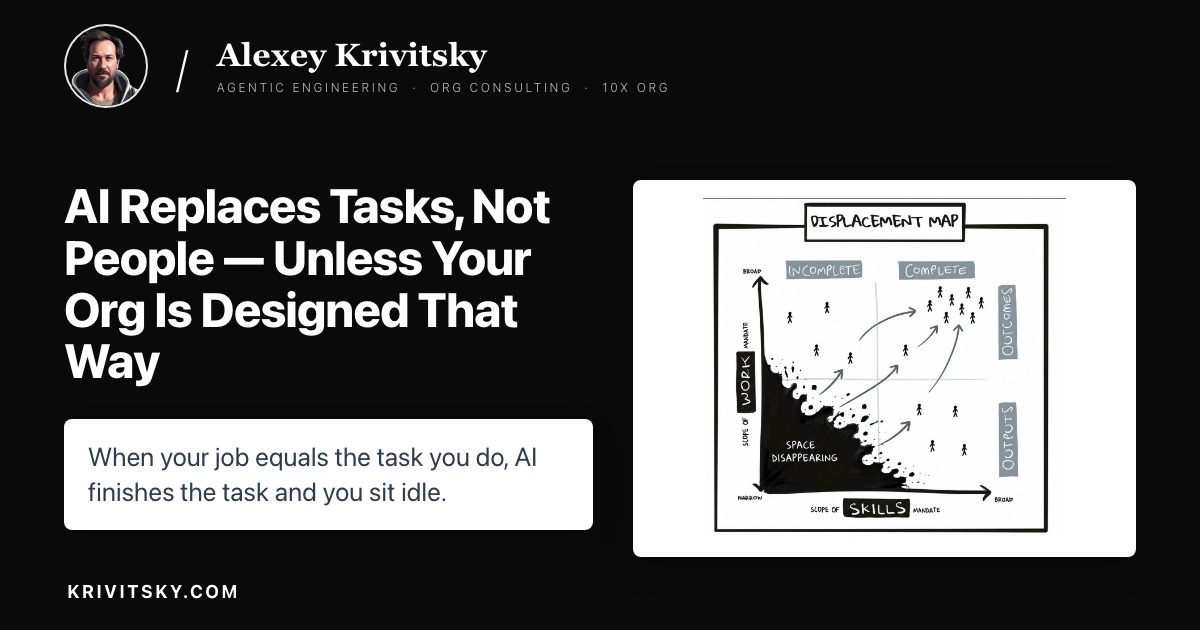
TL;DR:When your job equals the task you do, AI finishes the task and you sit idle. The fix is organizational, not technological — broaden mandates or watch displacement happen by design.
I talked to a CEO recently. He runs a 70-person company — deep learning for manufacturing quality control, video cameras on factory lines. His developers had been writing the code that trains and deploys those models. Then AI got good enough to do most of that work.
So he made them an offer: transition from developer to consultant. When AI handles the implementation, what's left for humans is understanding customer problems and driving solutions end to end.
Some developers took the offer. Some didn't.
The ones who didn't are now in an uncomfortable position. The CEO is hiring consultants externally and figuring out what to do with developers whose daily output AI can match in a fraction of the time.
This CEO is an exception. He didn't treat his developers as costs to be reduced — he saw them as potential to be developed. New titles, new mandates, a deliberately redesigned organization that offers people an elevated path when their current tasks get automated. Most companies don't do this. Most companies see the automation and reach for the headcount spreadsheet.
This is not an AI story. This is an org design story.
The Task Trap
Think about the roles in your organization. A database designer who only touches databases. A frontend developer who only writes React. A QA engineer who only runs test suites. Each role is scoped to a single task type, and each person's identity is wrapped around that scope.
When AI arrives, it doesn't evaluate whether you're a good database designer. It evaluates whether the task "design a database schema" still requires a human at all. If your job equals the task you do, and AI can do that task, the math is straightforward.
I worked with a database designer at a company I'll call DBN. Individually brilliant. With AI, his productivity on database work went through the roof — 100X by any reasonable measure. But the organization only allowed him to do database work. He was mandated to stay in his lane. When I ran the numbers, he had roughly 297 idle days per year. There simply wasn't enough pure database work to fill a calendar, even before AI made it faster.
AI didn't create his problem. It exposed it. Narrow specialization was already a fragile arrangement. AI just removed the ambiguity.
100X Individuals, 1X Organizations
Peter Steinberger runs 20 AI agents in parallel. Individual developers are hitting productivity numbers that would have been career-defining five years ago. The individual AI moment is real.
But organizations are still on their old trajectory. No tests, no documentation, mountains of tech debt, the same handoffs and queues and approval chains. Gary Hamel calls this the "crack of history" — powerful new technology wielded inside organizational structures designed for a different era. The mismatch, not the technology, is the problem.
Most companies respond to AI the way they responded to agile: layer it on top of the existing structure and hope the structure doesn't notice. The paradigm stays the same; only the speed changes. More code, faster. More designs, faster. More of exactly what you were doing before, at higher velocity, on the same trajectory.
That's the paradigm trap. You need to change the paradigm first, then amplify with AI. When you amplify first and change never, you're accelerating in the wrong direction. The Ferrari Trap applies perfectly here: a faster car on the wrong road just gets you to the wrong place sooner.
The Displacement Map
This is where the Org Topologies Displacement Map becomes useful. It has two axes: Scope of Work Mandate (narrow to broad) on the vertical, and Scope of Skills Mandate (narrow to broad) on the horizontal.
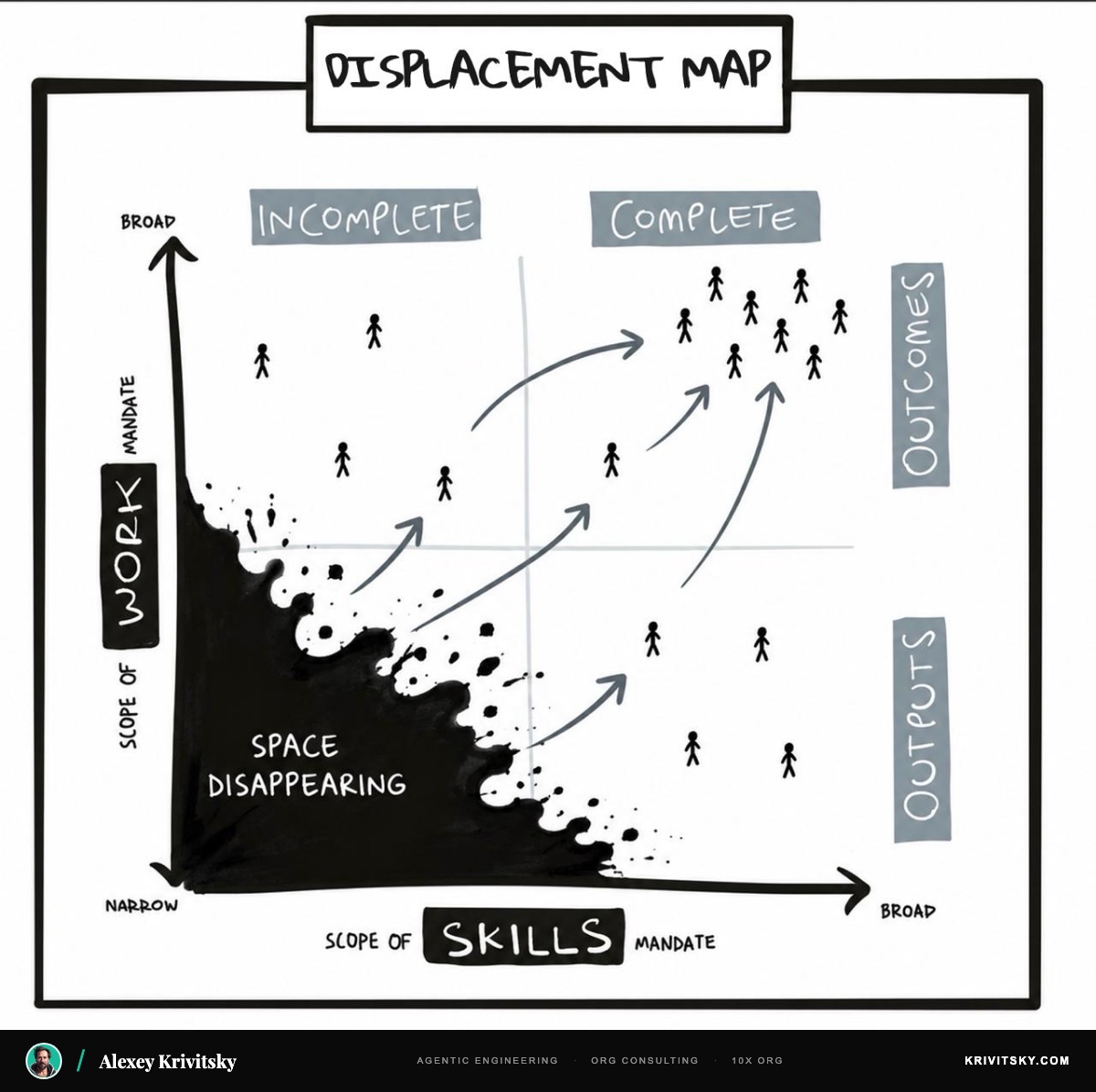
The bottom-left corner — narrow work, narrow skills — is the black zone. "Space Disappearing." That's where the DBN database designer sits. That's where every role scoped to a single repeatable task sits. AI compresses that space first.
The arrows on the map point up and to the right: from Outputs to Outcomes, from Incomplete to Complete. People who move in that direction own broader work (not just "write code" but "solve customer problems") and broader skills (not just databases but the full stack of understanding needed to deliver value). The top-right quadrant is where humans remain irreplaceable — not because AI can't do individual tasks there, but because the judgment, context-switching, and problem-framing required don't decompose into automatable units.
The CEO's offer to his developers was exactly this move. He was pointing at the top-right quadrant and saying: go there. Some made the shift. Others stayed put.
Elevation of Human Intelligence
What the CEO was describing — whether he used these words or not — is the elevation of human intelligence. You stop being an execution resource and start owning the bigger picture. On the Org Topologies map, that's the driving quadrant, where people figure out what to build, not just build what they're told.
This isn't about becoming a manager. It's about broadening what you're responsible for and what you're allowed to know. A developer who understands the customer domain, participates in discovery, owns deployment and monitoring, and can switch between value areas when demand shifts — that person doesn't have a task that AI replaces. They have a role that AI amplifies.
But here's the catch that most AI optimists skip over: the organization has to allow this move. And most don't.
The Organizational Ceiling
Most organizations are designed to prevent exactly the kind of broadening that makes humans resilient to AI displacement. The structure keeps people in narrow task boxes. Job descriptions define boundaries. Reporting lines enforce lanes. Performance reviews measure output within a specialty, not impact across a value cycle.
When AI finishes the narrow task faster, the person sits idle, and management sees rising costs with no matching improvement. Eventually it becomes a cost-cutting conversation, and engineers get associated with costs, not value. Not because AI replaced them, but because the organization was already designed to treat them as interchangeable task-executors. AI just made the price comparison unfavorable.
This is the ceiling. Individual developers can be 100X productive, but if the organization pins them to narrow streams and measures them on task throughput, the system absorbs none of that potential. 100X individual, 1X organization. The DORA 2026 report quantified this exact gap: individual developer effectiveness up, software delivery instability up right alongside it. The gains evaporate into idle time, overproduction of the wrong things, and queues that existed long before the first token was generated.
Two Wings
The structural fix maps to two organizational capabilities — what we call the Two Wings in 10X ORG.
Wing 1: Full value cycle mandate. Give people and teams ownership of the complete flow from idea to production. Not "the backend part" or "the QA step" — the whole thing. Fast-flow teams, not functional silos. When a team owns the entire cycle, AI accelerates the whole arc, not just one phase of it.
Wing 2: The ability to switch between value areas. As I explored in Two Wings of a 10X Bird, Wing 1 without Wing 2 is local optimization. A search team that owns its full value cycle is great — until search demand drops and that capacity sits unused. The organization needs people who can move between value areas as demand shifts. Unpin from streams.
Management has two dials to turn: grow multi-expertise (help people broaden their skills) and unpin from streams (stop assigning people permanently to one value area). These aren't binary switches. They're dials. You turn them gradually. But the point is that management must turn them, not leave them at zero and wonder why AI investments aren't paying off.
AI Broadens, Not Just Accelerates
Here's what gets lost in the "AI replaces jobs" narrative: AI is a broadening tool, not just a speed tool. Developers can open repositories they've never touched and navigate them with AI assistance. They can learn new domains faster, co-own systems they'd previously needed months of ramp-up to understand, and modify things they were never supposed to modify.
AI doesn't just make the database designer faster at databases. It makes the database designer capable of doing frontend work, infrastructure work, customer analysis. AI is a teacher as much as a doer. Organizations that recognize this and deliberately use AI to broaden their people's capabilities — rather than just to accelerate their existing narrow tasks — will find themselves in a completely different position.
The multi-learning idea isn't new, by the way. It was described in HBR in the late 1980s and was actually the core idea behind Scrum before the industry buried it under ceremonies and certifications. People are the real learning machines. AI makes that learning faster and cheaper than it has ever been. The question is whether your organization allows it.
AI Is a Threat, and a Savior?
AI can do more than accelerate your current work. It can help you broaden — acquire new skills, work across domains, own bigger problems. But only if your organization lets you. When it doesn't, you're not being replaced by AI. You're being replaced by a job description that was already too small for any human.
Keep People, Elevate the Work
AI automates tasks. It does not automate judgment, curiosity, or the ability to sit with a customer and hear what they're actually saying.
Humans are good at talking to customers, finding problems worth solving, connecting insights across domains, navigating ambiguity, and making decisions when the data is incomplete. These are the things that create value — and they don't decompose into prompts.
The question for every company isn't whether AI will automate tasks. It will. The question is what happens to the people who used to do those tasks. Do you broaden their mandates, invest in their growth, redesign the organization so they can take on bigger work? Or do you wait until the math catches up and the conversation turns to headcount?
The CEO in our story chose elevation. Most organizations haven't made that choice yet. The ones that do will find that AI doesn't reduce the need for people — it raises the bar for what people do.
Change the company — or change the company.
Alexey Krivitsky
Co-author of 10X ORG and co-creator of Org Topologies. Helps organizations rethink, redesign & rewire themselves for the AI era — from the codebase to the boardroom.

As a full-stack consultant, I operate across all three layers — AI Fluency, Team Flow & Org Fit. Talk to me to get a custom offer that matches your organization’s maturity to drive the impact.