Multi-Learning: 200 Years of the Wrong Model
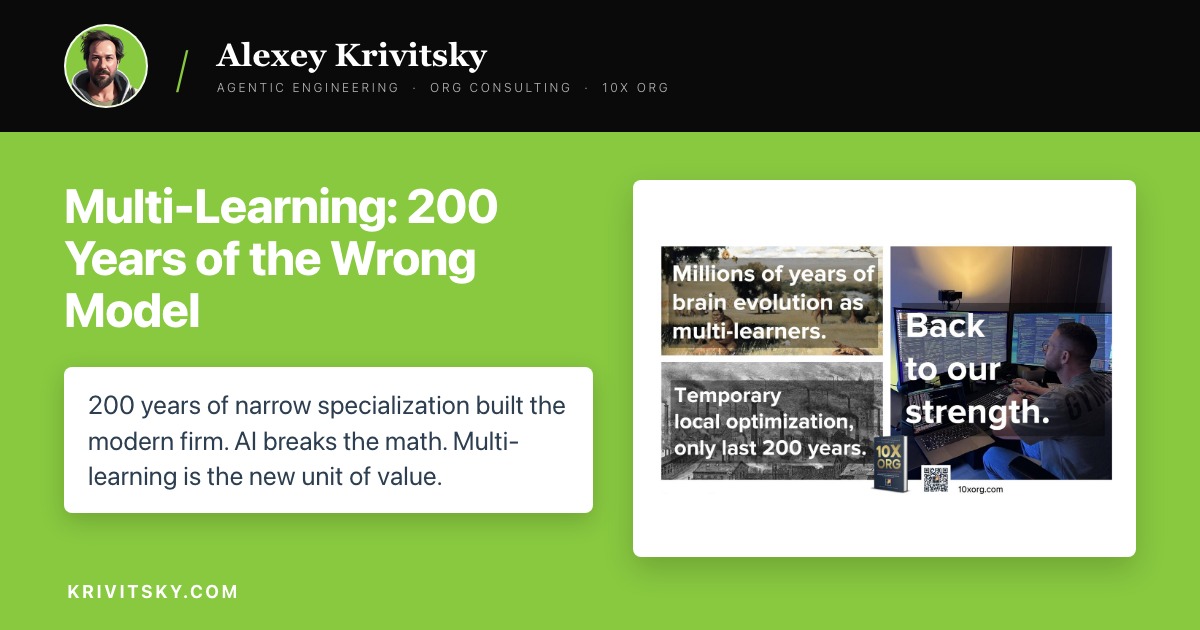
TL;DR:For six million years our brains evolved to learn across domains. Two hundred years of factory logic pinned people to single tasks. AI is automating the repetitive work that justified that pinning. What remains is exactly what our brains were built for: multi-learning.
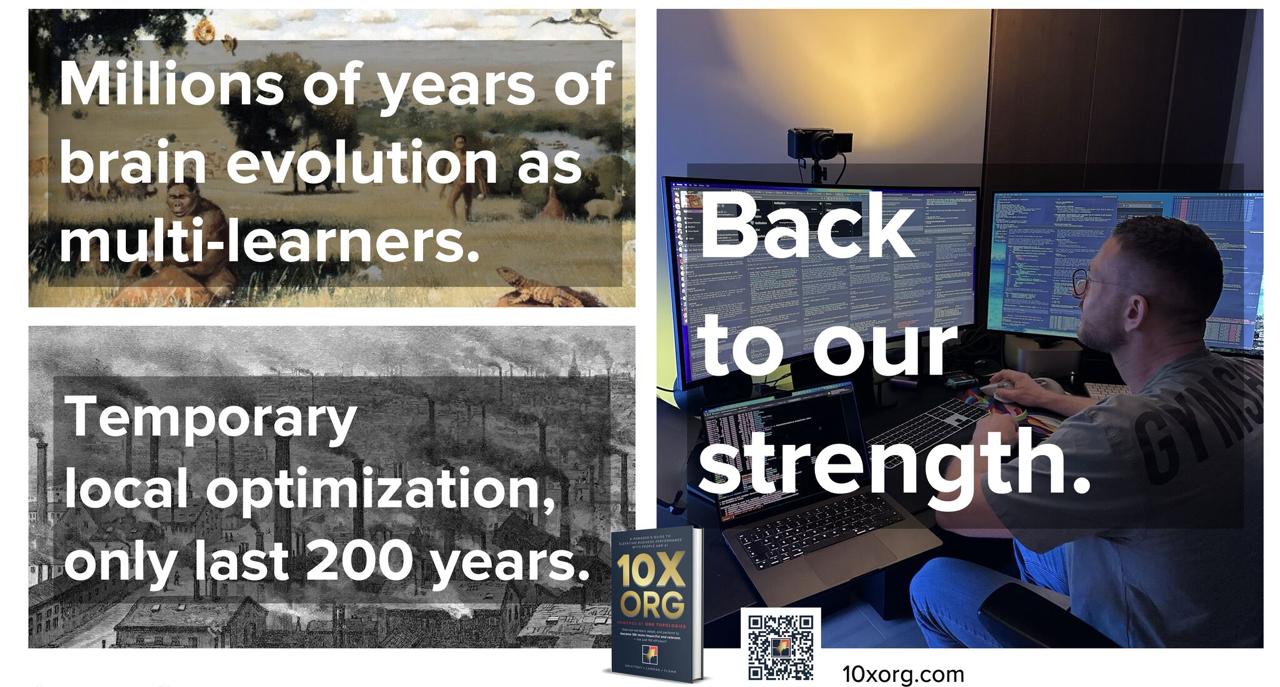
For millions of years, our brains evolved in environments that demanded everything at once. We hunted, gathered, raised children, fought, explored territories, developed languages, and sketched on cave walls. The same brain, the same day.
This is called "multi-learning" in scientific journals, but simply put, this is how humans naturally operate.
Then, about 200 years ago, someone realized you could make more money by putting a person on a single task. Cheaper to train. Easier to replace. The industrial revolution redesigned human activity around a principle that had nothing to do with the nature of our cognition.
That was a temporary optimization. A local maximum that lasted two centuries. But these are just a blink compared to the 6 million years of evolution of our species.
Now it's ending. As I argue in Redesign, Then AI, AI collapses the cost of learning — which erodes the very advantage that narrow specialization was built on.
AI is taking over the repetitive, routine work that justified pinning people to single tasks in the first place. And what's left is exactly what our brains were built for: learning across domains, directing, reasoning, envisioning, orchestrating, making judgment calls that no single-purpose agent can make.
Look at the best practitioners today. They're not narrower — they're broader. They sit at the center of their own organization of agents, directing work across boundaries that used to require separate departments.
In the photo on the right, it is not an AI-generated person; it is Peter Steinberger, the creator of the famous OpenClaw, carefully driving this stack of dozens (hundreds?) of AI agents working for him.
We spent 200 years suppressing our strongest capability to make the factory floor more efficient. The factory floor is automated now. And when people stay pinned to narrow tasks in this new reality, AI doesn't replace them — the org design does.
Time to go back to our strength. To multi-learning at work, which we know so well from non-office hours. Organizations that embrace this shift need both wings — full ownership of the value cycle and the ability to switch when value shifts.
Alexey Krivitsky
Co-author of 10X ORG and co-creator of Org Topologies. Helps organizations rethink, redesign & rewire themselves for the AI era — from the codebase to the boardroom.

As a full-stack consultant, I operate across all three layers — AI Fluency, Team Flow & Org Fit. Talk to me to get a custom offer that matches your organization’s maturity to drive the impact.