Two Wings of a 10X Bird
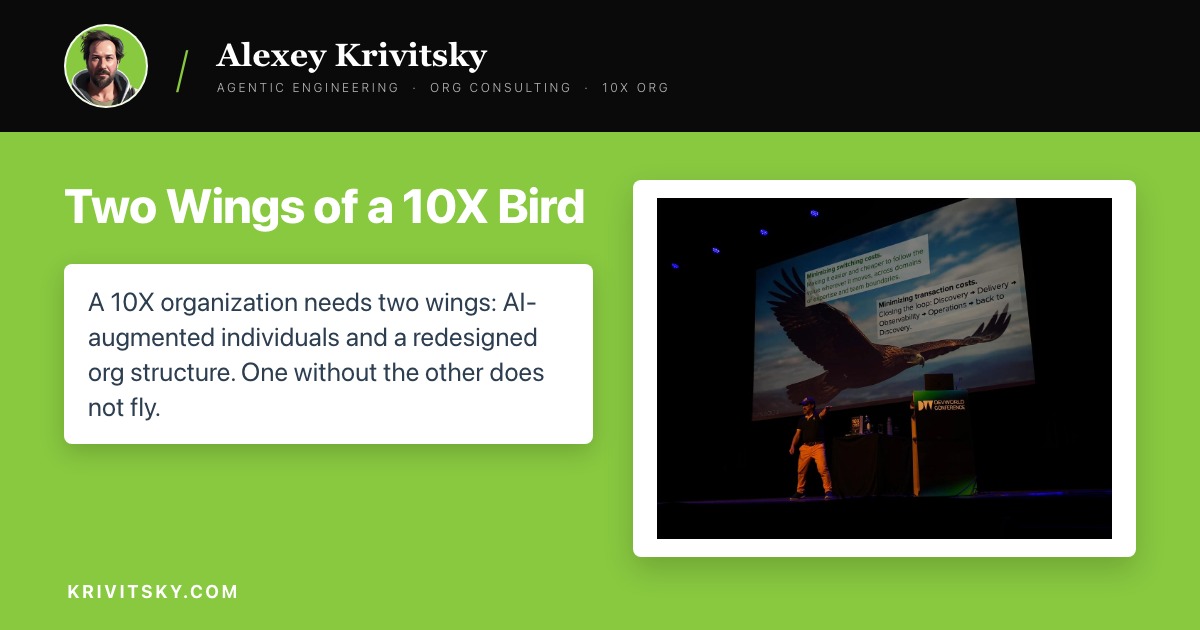
TL;DR:A 10X organization needs two wings: near-zero transaction costs (no handoffs slowing the learning loop) and near-zero switching costs (redirect when value shifts). Most AI adoptions only address one wing. That is why 100X individual gains fail to compound into system performance.
A two-person startup just redesigned a live publishing platform with AI. One prompt builds a working online shop in thirty minutes. The 100X is real.
But why? What makes a tiny team 100X while your organization — with better engineers, deeper pockets, and more data — barely moves the needle?
Two things. Two wings.
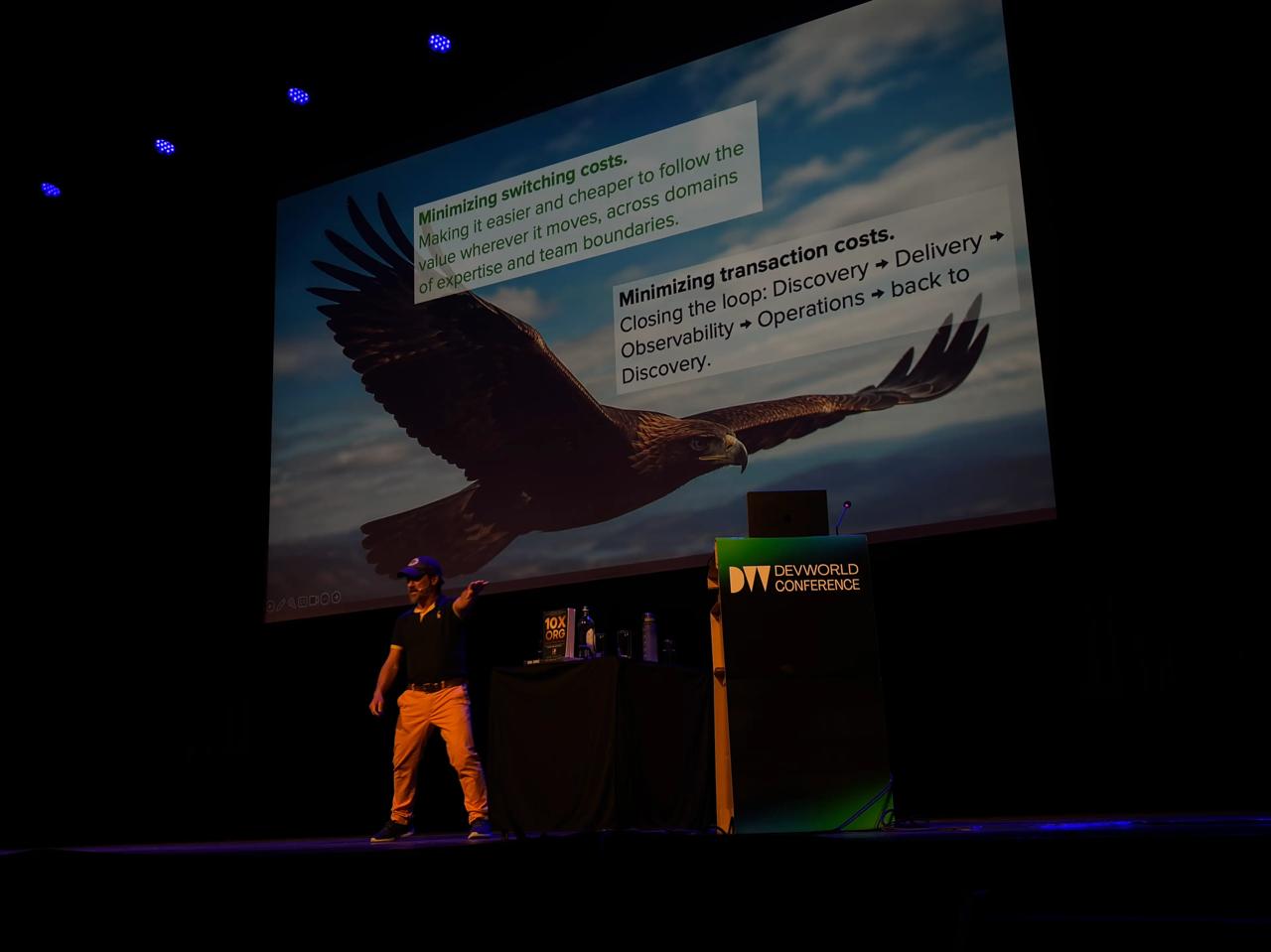
Wing one: transaction costs are near zero. A small team runs the full cycle — discovery, delivery, observability, operations and back to discovery— without handing anything off to anyone. No tickets across team boundaries. No three-week intake process. They outlearn everyone because nothing slows the loop.
Wing two: switching costs are near zero. When the data says pivot, they pivot by Tuesday. No sunk-cost roadmap. No six teams committed to last quarter's plan. They don't just run fast — they run the right direction, and they change direction the moment it stops being right.
Running fast isn't enough if you're running the wrong way. Running the right way isn't enough if every course correction takes a quarter.
Now look at how most organizations adopt AI.
The resource model: give every specialist an AI license. The database designer finishes in three days. Then waits. Transaction costs? Through the roof — every handoff, every "wait for the other team." Switching costs? Impossible — people are pinned to their specialty. Neither wing works. This is the Ferrari Trap — faster cars on a jammed highway.
The delivery model: cross-functional teams with AI. Better — the BML (Build-Measure-Learn) loop runs fast inside each lane. But teams can't repoint to where the real value is. They're locked to their stream. One wing flaps. The other is pinned.
The adaptive model: teams that co-own broad customer problems, acquire skills across boundaries, and redirect when value shifts. Both wings work. That's where 100X individual gains compound into 10X organizational performance — what multi-learning makes possible when the org structure allows it.
Most AI adoption conversations start with tools. The better question is: which wings does your organization have? As the DORA 2026 data confirms, individual developers are measurably faster — but team-level delivery is flat or worse when the structure hasn't changed.
Material from the 10X ORG book tour leanpub.com/10xorg — Amsterdam next week (LeSS meetup May 7, DevWorld May 8).
Alexey Krivitsky
Co-author of 10X ORG and co-creator of Org Topologies. Helps organizations rethink, redesign & rewire themselves for the AI era — from the codebase to the boardroom.

As a full-stack consultant, I operate across all three layers — AI Fluency, Team Flow & Org Fit. Talk to me to get a custom offer that matches your organization’s maturity to drive the impact.