The Ferrari Trap
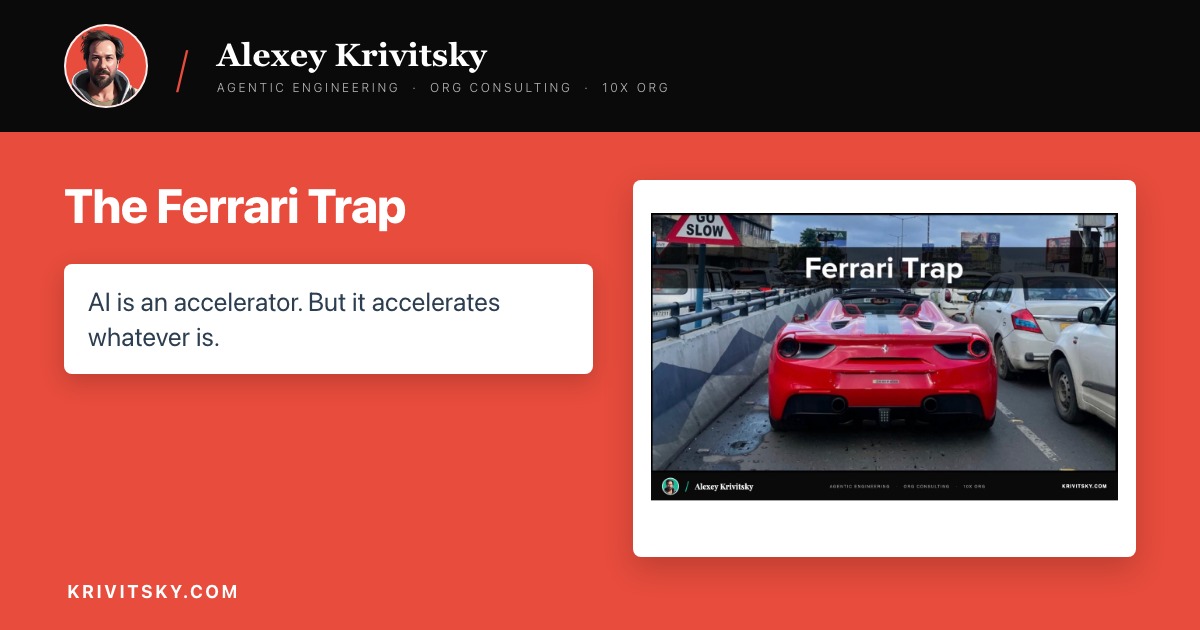
TL;DR:AI is an accelerator — but it accelerates whatever is. Developers expected 24% speedup from AI — actual result: 19% slower. The Ferrari Trap: faster cars on a jammed highway. Fix the road first.
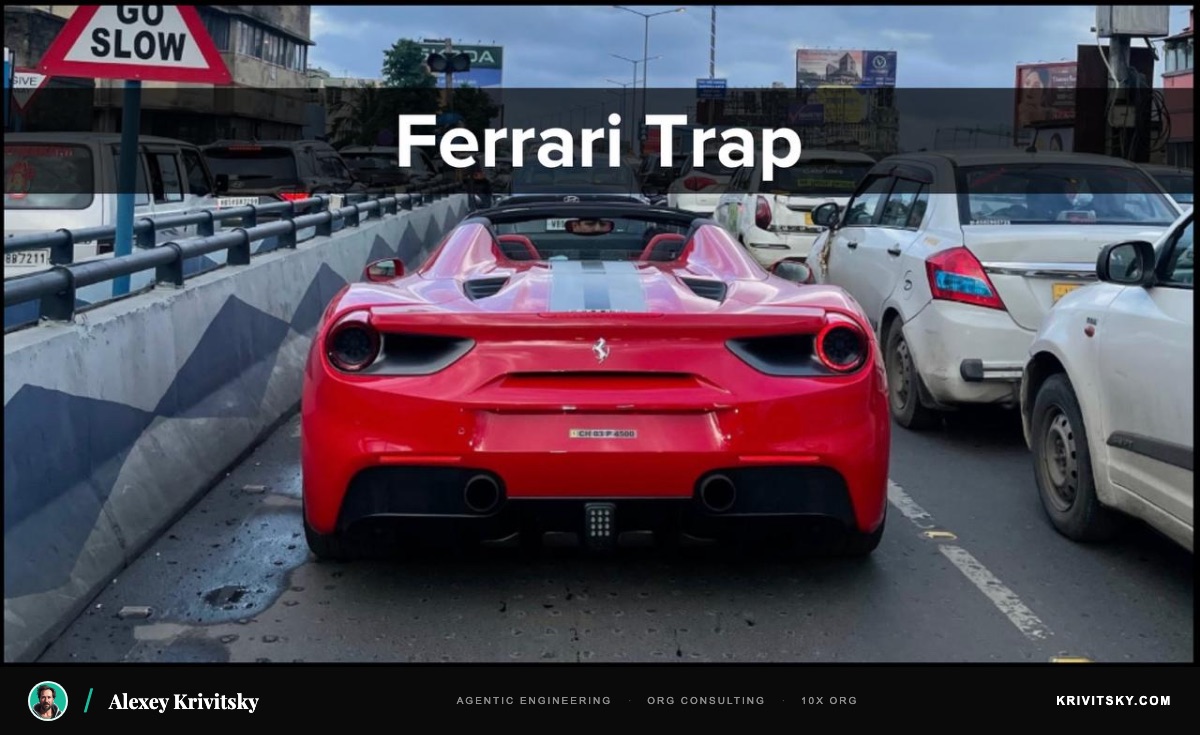
METR — a respected AI evaluation organization — ran a randomized controlled trial with sixteen experienced open-source developers across 246 real issues. Developers expected a 24% speedup from AI assistance. Actual result: 19% slower. And even after experiencing the slowdown, they still believed AI sped them up by 20%.
That perception gap is the Ferrari Trap in one sentence. The feeling of speed without the reality of progress.
Everyone's engine is revving louder. The cars are still stuck.
In 10X ORG, we call this the Ferrari Effect. But I've started calling it the Ferrari Trap, because "effect" sounds like something that happens to you. A trap is something you walk into — and most organizations are walking into it with their eyes open and their wallets out.
The Metaphor
Aiden, the AI advisor in 10X ORG, explains it to Hanna, the Head of HR, after she asks why the roadmap is still slipping even though every developer is moving faster:
"Think about car traffic. The goal is for cars to move fast and get where they're going. But what we often get are traffic jams. Now imagine swapping every car for a Ferrari. Although each one could now go much faster, that alone doesn't fix congestion."
Hanna tries to absorb this. "So... if we've got AI super-specialists revving their engines... this is not helping?"
"We're just flooding a blocked highway with faster cars. And more cars mean more traffic, more traffic means less flow."
After a pause: "Perhaps we should fix the road first — and only then let the AI-powered Ferraris fly."
The metaphor lands because everyone has felt it. Your database designer finishes the month's workload in three days. Then waits. Your frontend team triples their output. Then waits — for the backend team, for the architect review, for the product manager who owns the intake queue. Individually, they're Ferrari-fast. Organizationally, the roads haven't changed since 2003.
The Data
Faros AI's research found the same pattern in delivery metrics: developers completed 21% more tasks and merged 98% more pull requests. But PR review time increased by 91%, and AI-generated code produced 1.7 times more issues than human-written code. Net organizational throughput: flat.
Meanwhile, an NBER study of six thousand CEOs and CFOs across the US, UK, Germany, and Australia found that 90% said AI has had no impact on productivity or employment — even though 70% actively use it. The modern Solow paradox. Executives average 1.5 hours per week of AI use. The cars are faster. The highway is still blocked.
The Ferrari Trap in Siloed Specialists
The Ferrari Trap isn't a failure of intelligence. It's a failure of paradigm.
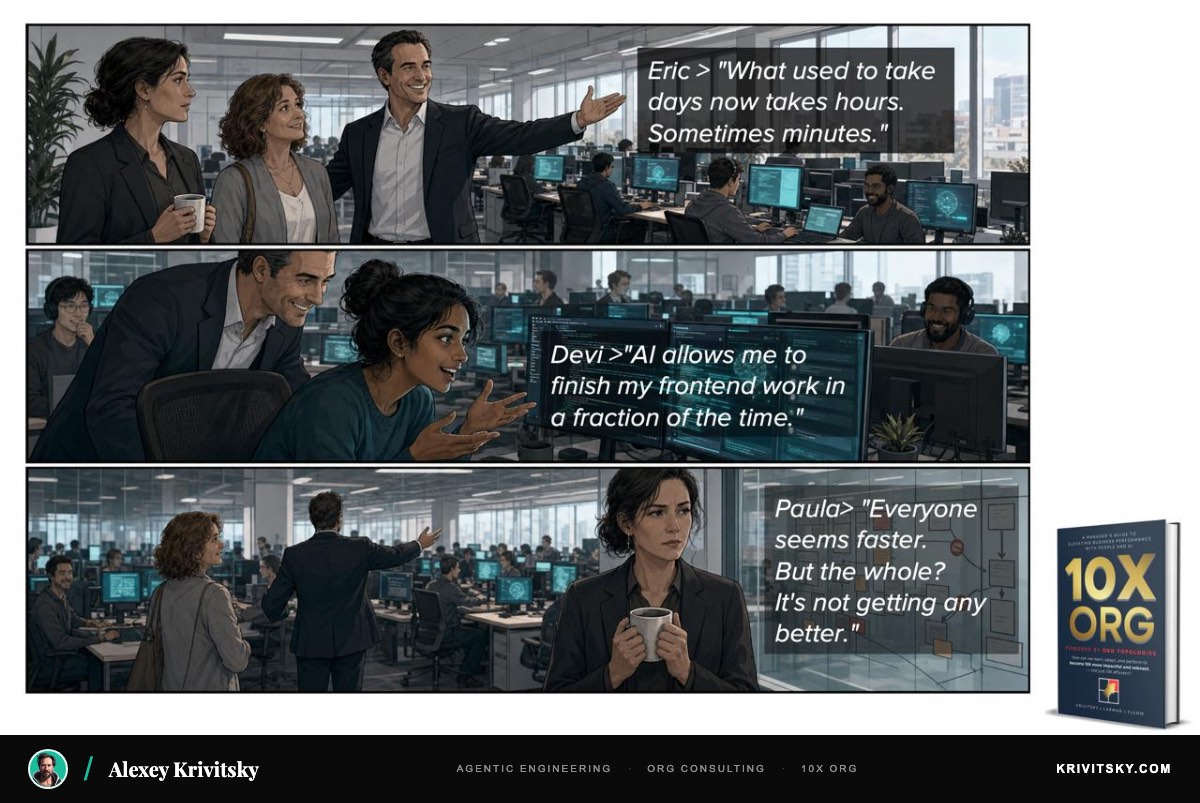
In the book, Eric — the Director of Engineering — takes Paula, the newly hired Head of Product, on a tour of the development floor. Paula owns the roadmap. She sees execution performance across all teams — not one team's velocity, but whether the whole system delivers on its commitments. Devi, a frontend developer, is tripling her output with GenAI. Eric can barely contain himself: "What used to take days now takes hours. Sometimes minutes." Paula watches, then says quietly: "Everyone seems faster individually. But the whole? It's not getting any better."
Paula had spotted the jam. Eric was still admiring the Ferraris.
Eric isn't wrong about the individual gains. He's wrong about what they add up to. And that's the trap: the local evidence is overwhelmingly positive. Dashboards light up. Sprint velocity doubles. Every team demo is impressive. The data says faster. The roadmap says stuck.
The problem is structural. When specialists in silos all accelerate, they produce more work-in-progress that jams organizational queues. Dependencies between teams create bottlenecks that local speed can't resolve. Handoffs, waiting, and coordination overhead dominate total cycle time. You're not speeding up the constraint. You're speeding up everything except the constraint — which is the organizational structure itself.
Amdahl's Law, from computing, formalizes this: the speedup of a system is limited by the fraction of the system that can't be improved. If 80% of your end-to-end delivery time is spent in queues, handoffs, and coordination, then making the remaining 20% infinitely fast still only gives you a 25% improvement. AI tools can't fix the 80%. Only redesign can.
The Ferrari Trap in Fast-Flow Teams
But what if your organization already did the transformation? What if you built autonomous, cross-functional teams — each owning their full value stream from idea to production?
You're still vulnerable.
Consider a typical post-transformation setup: a search team, a payments team, a recommendations team. Each cross-functional. Each empowered. Each fast inside its lane. They've got what 10X ORG calls Wing One — full ownership of the value cycle. No handoffs, no waiting, no review queues.
Now add AI. The search team accelerates search. The payments team accelerates payments. But demand for search stabilizes — the product doesn't need more search improvements. Meanwhile, a new AI-powered capability needs building urgently, and the people best suited for it are pinned to a payments lane that's already saturated.
These teams can't switch. They're autonomous inside their lanes but locked to them by design. When value shifts — and with AI, it shifts fast — they can't follow it. They hit what we call the demand ceiling: speed without scope.
This is the one-winged bird. Wing One without Wing Two — ownership without flexibility. AI hits the demand ceiling in each lane, and the organization has no mechanism to redirect capacity where it matters most. The Ferrari is fast on its road. But when the road ends, it can't change lanes.
The Accelerator Problem
AI is an accelerator. But it accelerates whatever is. If you had a traffic jam before AI, you're going to have a faster one now — burning tokens, revving engines, but not moving value.
If your organization was building the wrong thing, it now builds the wrong thing faster. If your teams were producing untested code, they now produce more untested code. If your culture rewarded output over outcomes, AI turns that reward function into overdrive. If your org was into crap coding, it's now faster at crap coding.
This is what makes the Ferrari Trap especially dangerous: AI doesn't just amplify speed — it amplifies trajectory. Gary Hamel observed that we're running 21st-century technology on 19th-century management principles. AI walked into most organizations and found exactly that arrangement. It didn't disrupt the structure. It accelerated the structure. And an accelerated misfit is worse than a slow one, because it burns resources faster, creates more waste, and the gap between the organization's self-image ("We're an AI-powered company!") and its actual performance widens with every token purchased.
Sooner or later, leaders notice. "We rolled out copilots and GenAI licenses," they say, "but we saw no meaningful performance gain." What they do see is higher running costs — AI licenses, training budgets, consultants. These are symptoms of non-strategic AI adoption: naive, sporadic, ad hoc — spreading AI across existing silos and hoping it will do the trick.
Fix the Road
Paula's line in 10X ORG lands hard because it reverses the instinct: "First design, then AI."
Most organizations do the opposite. They buy the tool first, distribute it widely, measure individual adoption, and then wonder why the organizational needle didn't move. They're trying to solve a structural problem with a technology purchase.
The structural problem has a name in Org Topologies: narrow mandates. When a database designer is mandated to touch only databases, AI makes her finish the work in three days — then she sits idle for twenty-seven. Nobody needs a thousand times more databases. When a search team is mandated to own only search, AI makes them ship search improvements at record speed — then they hit what we call the demand ceiling. Speed without scope. The lane becomes the constraint, not the pace within it. The question isn't whether AI replaces people — it's whether your org structure turns displacement into elevation or just idle time.
The fix maps to two organizational capabilities — the Two Wings in 10X ORG. Wing One: give people and teams ownership of the full value cycle, from idea to production. Not "the backend part" or "the QA step" — the whole thing. Wing Two: enable switching between value areas. A team that can redirect its capacity when demand shifts, instead of sitting idle inside a lane that doesn't need more work.
Management has two dials to turn: grow multi-expertise (help people broaden their skills — AI makes this faster than ever) and unpin from streams (stop assigning people permanently to one value area).
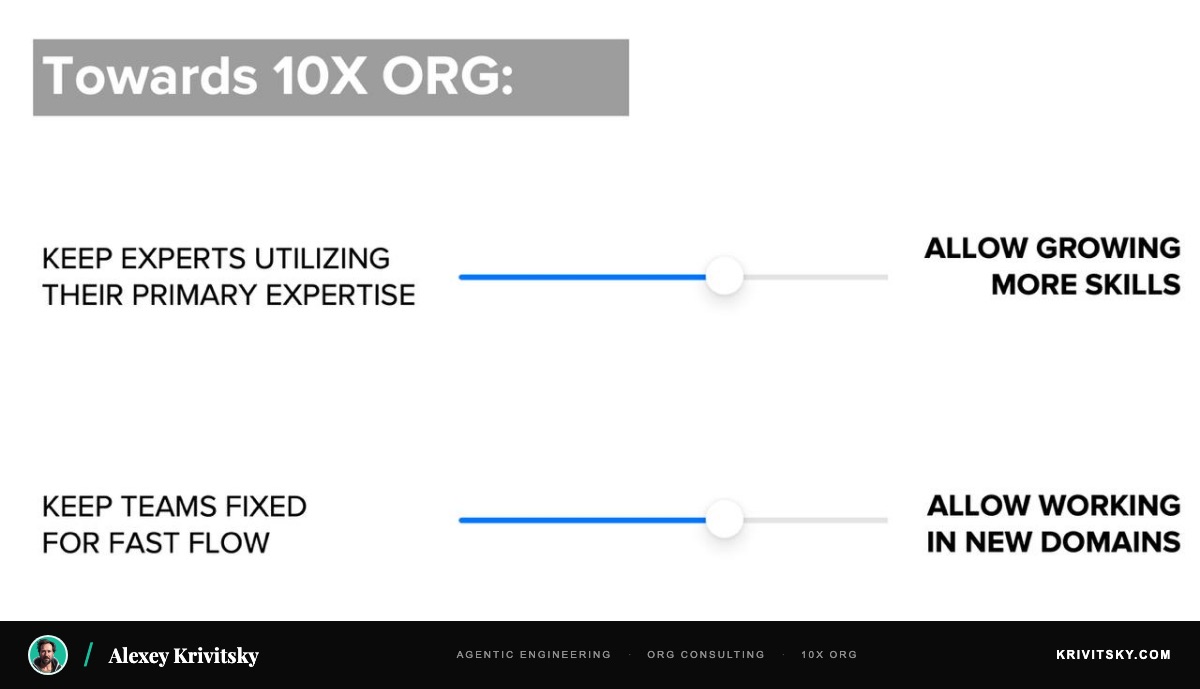
These aren't binary switches. They're dials you turn gradually. But someone has to turn them. Leaving them at zero and distributing AI licenses is how you buy more Ferraris for the same jammed highway.
Recognizing the Trap
You're in the Ferrari Trap if:
Your developers report feeling significantly faster while your roadmap timelines haven't meaningfully improved. Your AI spend is climbing but customer-facing outcomes are flat. Your teams are producing more pull requests, more code, more artifacts — and your cross-cutting initiatives still take quarters. Your sprint demos are impressive, and your annual planning conversation sounds the same as last year.
The uncomfortable question from 10X ORG that I now ask in every workshop: "Where are you seeing local speed improvements that still don't show up in roadmap-level progress?"
Every hand goes up.
Escaping
The sequence matters. Redesign, then AI. Not the other way around.
That doesn't mean stopping AI adoption. Try it everywhere — that's fine and necessary. Learn what it does to your system. Watch where the Ferrari Trap appears, where the demand ceiling hits, where faster workers produce longer queues. Use the evidence to diagnose where the structure, not the tooling, is the constraint.
AI is an accelerator. It will accelerate whatever is. So point it at the right thing. Use it to accelerate improving your organizational design — broadening mandates, compressing the multi-learning curve, dissolving the silos — instead of revving harder inside a jammed highway.
Alexey Krivitsky
Co-author of 10X ORG and co-creator of Org Topologies. Helps organizations rethink, redesign & rewire themselves for the AI era — from the codebase to the boardroom.

As a full-stack consultant, I operate across all three layers — AI Fluency, Team Flow & Org Fit. Talk to me to get a custom offer that matches your organization’s maturity to drive the impact.