Agentic Factory: Which Level Are You Automating?
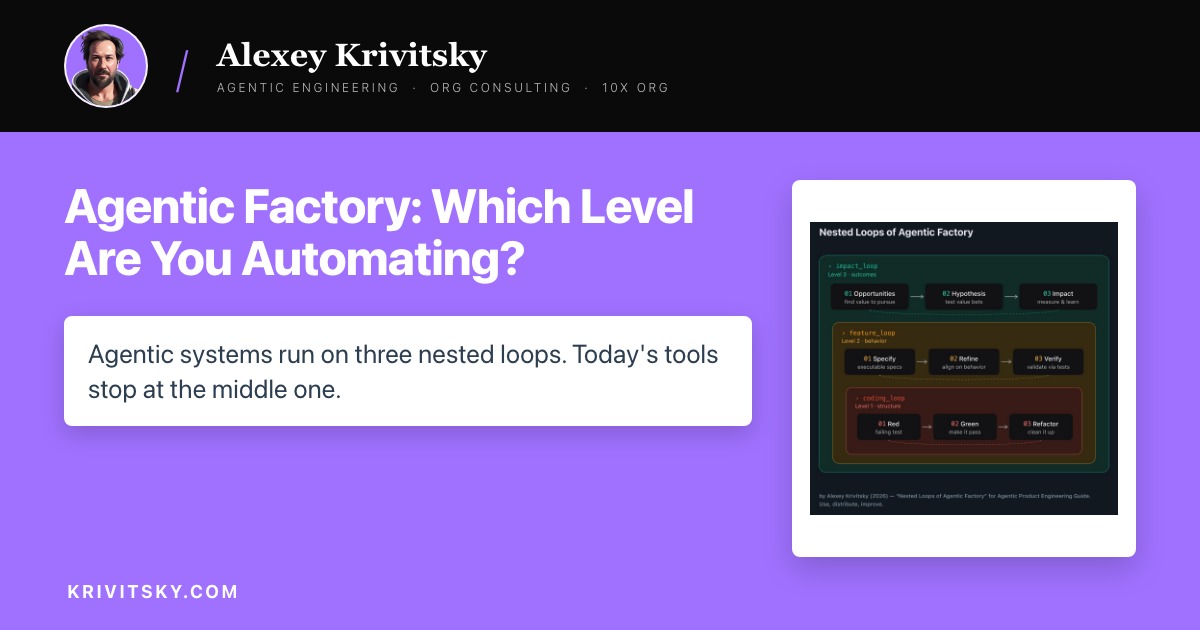
TL;DR:Coding Loop, Feature Loop, Impact Loop — three nested agentic loops. Most agentic tools stop at the middle. The outer loop is the one that matters.
Yesterday I got a chance to participate in an insightful webinar by Benedikt Stemmildt, "Don't build features, build factories."
Benedikt was very clear in the very beginning that he didn't like the term feature factory. I agree it carries a weight, as it is used to contrast intelligent value-adding to mechanically factory-like outputting of stuff.
I agree. And that got me thinking, so I had to reconceptualize the factory thing. Below is my take.
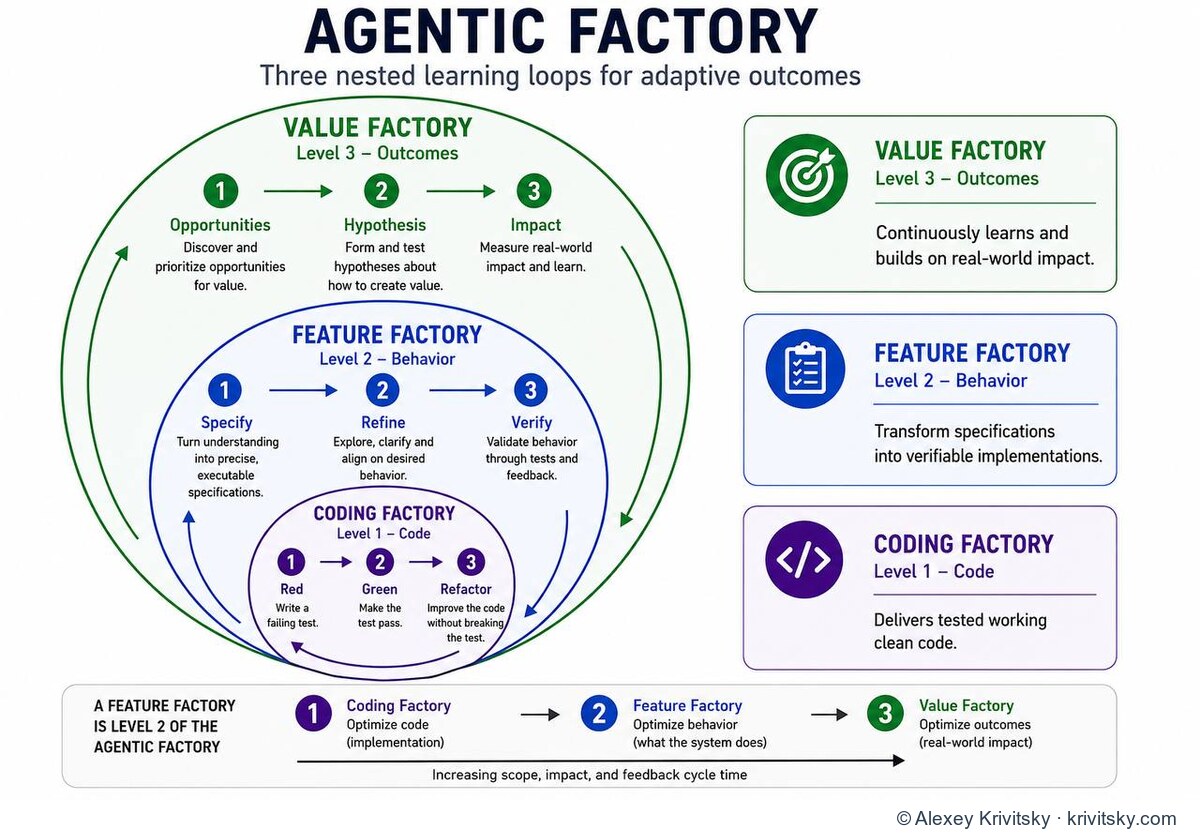
Agentic AI systems operate through nested work-and-learning loops.
1) Coding Factory
The innermost loop is the Coding Loop, where agents (AI and in older times human programmers) optimize implementation quality through rapid feedback cycles such as Red → Green → Refactor. This loop is excellent at producing working tested code. Yet having only one loop, such a Coding Factory can optimize toward technically correct irrelevance, as more code doesn't mean more value.
This is the same trap I described in The Ferrari Trap — a faster engine doesn't help if it's pointed at a wall.
2) Feature Factory
The next level system is the Feature Factory, which adds a Feature Loop (on top of a Coding Loop): Refine → Specify → Verify. This is where behaviors, workflows, and executable specifications emerge.
As of mid year 2026 all current "agentic product development" systems describe this level of AI automation. They become highly efficient factories capable of generating and validating functionality at scale. However, obviously feature optimization alone does not guarantee meaningful outcomes either, so here humans are required to operate the factories, directing and ensuring the value. It's the same gap I keep circling in Pair Programming in the AI Era and AI-Native vs. AI-Augmented.
3) Impact Factory
Adding the outermost Impact Loop: Opportunity → Hypothesis → Impact turns the system into a real Impact Factory.
The external loop continuously learns from real-world effects and redirects the lower loops toward meaningful goals.
Imagine three concentric feedback systems in motion: at the center, code rapidly iterates toward correctness; around it, features evolve toward usability and coherence; and at the outer edge, real-world signals continuously reshape priorities based on measurable impact. Each loop feeds constraints and learning inward, while insights from the inner loops propagate outward, creating a living adaptive system rather than a linear production pipeline.
In this model, a common "Feature Factory" is not the final stage of agentic AI maturity — it is only the middle layer. The progression from Coding Factory to Feature Factory to Impact Factory reflects an expansion in what the system is capable of learning from: first implementation correctness, then behavioral usefulness, and finally real-world impact. (I've written before about how AI amplifies whatever trajectory your org was already on — a Feature Factory with no Impact Loop is that amplification made literal.)
Each outer loop constrains and guides the inner loops, ensuring that local optimization contributes to broader objectives rather than drifting into isolated efficiency.
Truly adaptive agentic systems require all three nested loops: code optimization, behavioral optimization, and outcome optimization.
To learn more about building these levels with an 8-tier model for mastering agentic product engineering, see the Agentic Engineering Guide.
Alexey Krivitsky
Co-author of 10X ORG and co-creator of Org Topologies. Helps organizations rethink, redesign & rewire themselves for the AI era — from the codebase to the boardroom.

As a full-stack consultant, I operate across all three layers — AI Fluency, Team Flow & Org Fit. Talk to me to get a custom offer that matches your organization’s maturity to drive the impact.