When Contributors Are Complete (1/2): The Super Individual Contributor and the Guild Hypothesis
TL;DR:AI restores the end-to-end craftsperson — a Complete Super Individual Contributor (IC). But whole individuals alone aren't an organization. The medieval guild shows what they still need — quality, learning, reputation — and where even that falls short.
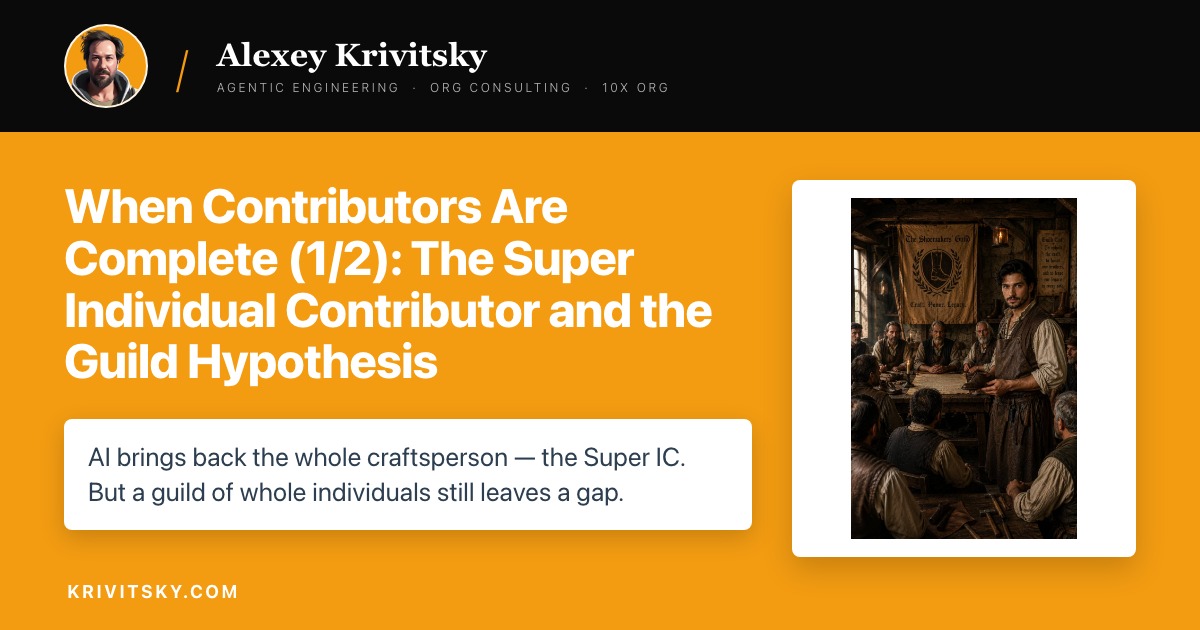
A shoemaker in fourteenth-century Florence made the entire shoe. Cut the leather, shaped the last, stitched the sole, finished the edges. He was a specialist — nobody confused a shoemaker with a blacksmith — but inside his craft, he was whole. He owned the work from raw material to finished product.
Nobody micromanaged the craftsmen into splitting the shoemaking process into phases and components and assigning individuals to work on those parts alone.
Software followed the same arc. In the 1960s and 1970s, a programmer was a craftsperson. You took a problem, understood it, designed the solution, wrote the code, tested it, deployed it. You owned the whole thing. The craft was whole.
Then came the pin factory.
The 200-Year Detour: The Pin Factory
Adam Smith's pin factory is where the modern story begins. One worker draws the wire, another straightens it, a third cuts it, a fourth sharpens the point. Eighteen operations, eighteen specialists. Productivity explodes — but any one of those workers, pulled out of the line, cannot make a pin.
The industrial revolution did this to everything. For two hundred years, the dominant organizational logic has been fragmentation: break complex work into narrow tasks, assign specialists, coordinate through hierarchy and process. The factory model.
Adam Smith said: "Concentrating each worker on a single subtask often leads to greater skill and greater productivity than if each worker tried to make a whole product on their own". And then he showed more than 1'000-times improvement to the pin manufacturing when using the single-worker paradigm.
Following this claim, many crafts were Shattered.
How the Software Craft Was Shattered
Three forces broke software into fragments:
Scale. Systems outgrew what one mind could hold. Mainframes gave way to distributed architectures, and distributed architectures demanded people who could think about databases, networks, UIs, and business logic separately.
Taylorism. The factory metaphor infected software. Waterfall is literally an assembly line: requirements → design → implementation → testing → deployment. Each phase owned by a different group. The org chart became the production line.
Vendor economics. Oracle DBAs. Microsoft stack developers. Cisco network engineers. Platforms created captive niches, and those niches became careers. The vendor's business model shaped the profession's structure.
By the early 2000s, delivering a single feature might require a business analyst, a UX designer, a frontend developer, a backend developer, a database administrator, a QA engineer, and an ops person. Seven people touching seven fragments of one thing.
Are you working in a pin factory? –— our famous quote in the 10X ORG book.
The Agile Cure
Cross-functional teams were the fix. The Agile movement recognized that fragmentation was the disease and tried to reassemble the craft inside a team boundary. Put all the specialists in one room, give them a shared backlog, let them self-organize. The team becomes the unit that can deliver end-to-end — even if no individual inside it can.
It worked, to a degree. A well-formed cross-functional team delivers faster and with fewer handoffs than a collection of functional silos. Scrum, Kanban, XP — these approaches made fragmented organizations more effective at coordination.
But they didn't restore the craft — because the fragmentation was baked into the org design itself. Scrum perhaps went the furthest, with its strong push for multi-learning within a team. But we know how that story goes. The team members largely stayed narrow specialists, reinforced by the career paths built around them. The team was the whole; the people were the parts.
What made it harder still: many organizations treated agile as a team-level improvement. So instead of optimizing the whole product, they assigned teams to lanes and locked them there.
And the teams were locked in lanes. Each stream-aligned team owned its domain — search, payments, checkout. Efficient inside the lane. But when demand shifted, when the market moved, when a cross-cutting opportunity appeared — the convoy couldn't scatter and reform. This is the Ferrari Trap applied at the team level: faster inside the lane, paralyzed between lanes.
How does the saying go in systems thinking? "The cure can be worse than the disease." This was perhaps exactly that.
AI Makes the Individual Whole Again
Large language models and agentic AI tools are collapsing the specialization gradient. A developer with Claude or Copilot can write frontend and backend, design a database schema, draft tests, configure CI/CD, write documentation, and handle deployment — competently, in a single session. They can even open up an unfamiliar repository and figure out how to change it — learning the codebase alongside the AI. Not because the developer became a polymath overnight, but because the AI fills the specialist gaps in real time.
We are seeing the return of the end-to-end craftsperson. Not the generalist who does everything poorly — the augmented craftsperson who does the whole thing well, with AI as the master's toolkit. And not just shipping code — working end to end on a complete customer problem. That's a jump straight to the top-right quadrant of the Org Topologies map: Driving Intelligence.
This isn't speculation. It's happening. Solo developers are shipping full products. Small teams are building what once required departments. The "super individual contributor" (Super IC) pattern — a single individual plus AI doing the work of a small team — is already a recognized mode of production.
And this raises a question that goes beyond AI as a technology — to its implications for organizational design:
If the individual is whole again, what are the teams and organization for?
The Guild Hypothesis
The naive answer is "we don't need teams." That's the Super IC trap — the fantasy that organizations become collections of autonomous individuals, each shipping their own thing. It sounds liberating. And when your product is a shoe, it perhaps makes a lot of sense. But in product R&D — at small scale and large — it inevitably produces local optimizations, waste, and even chaos. And worse: people inside the organization stop understanding what's being built. Organizational learning stops.
Is there something we can learn from the medieval shoemakers here?
When every craftsperson was end-to-end, they didn't work alone. They formed guilds. And guilds existed for exactly the things that end-to-end craftspeople couldn't provide individually:
Quality standards. The guild set the floor. A master's stamp meant the work met a known standard. Without it, every buyer assessed every craftsperson from scratch. The guild was a trust infrastructure.
Training and learning. The apprentice-journeyman-master pipeline ensured that knowledge transferred across generations. No individual craftsperson could reproduce the profession alone. The guild was the learning organism.
Reputation and market access. The guild's collective name opened doors that no individual name could. Buyers trusted the guild, and that trust flowed to its members. The guild was a brand.
Innovation diffusion. New techniques spread through the guild network — across workshops, across cities. A discovery in one workshop became common practice across the profession. The guild was the knowledge network.
Collective negotiation. Trade rights, pricing, workspace access — these were guild-level conversations. No individual craftsperson had the leverage. The guild was the political actor.
None of these are production functions. The guild didn't coordinate who makes what. It created the conditions under which individual craftspeople could be trusted, could learn, could access markets, and could improve.
My hypothesis: when AI makes individuals whole again, the organization itself becomes a guild.
Perhaps, in some way, this is true. Not "teams become guilds." The organization. The entire structure shifts from coordinating fragments of production to providing what whole craftspeople need from a collective.
This maps directly to what we call the Adaptive Topology in Org Topologies. The factory is the Resource Topology. Agile teams are the Delivery Topology. The guild is the Adaptive Topology — seen through a new lens.
Where the Guild Is Enough — and Where It Isn't
A consulting firm is a guild, and it works. Each consultant takes their own engagements end-to-end. The firm provides reputation (the name opens doors), quality standards (up or out), learning (training programs, knowledge sharing), and market access (the sales machine). The work is genuinely independent — my engagement doesn't depend on your engagement shipping first. Privateers with separate destinations? Fine. The guild functions are all they need.
But product R&D has shared outcomes. My search improvement is useless if your checkout breaks. The user experiences the product, not the individual contribution. The work is interdependent by nature — not because we chose to make it so, but because the customer demands coherence.
Here are some basic heuristics:
- Independent work (consulting, freelancing, research labs) → Guild is enough. Privateers work. Each ship has its own destination.
- Interdependent work (product R&D, integrated systems, platform companies) → Guild is necessary but not sufficient. You need the flotilla.
Most of my clients adopting AI are in the second category. And that's where the guild gap bites.
The Guild Gap
Consider a small robotics startup. Ten people, all AI-augmented, all capable of working end-to-end. Each one is a whole ship — independently navigable, independently capable. They have the guild functions: shared standards, a learning culture, collective reputation.
But they're privateers. Each capable vessel sailing roughly the same waters, serving roughly the same customers — yet without shared intelligence, without formation discipline, without the infrastructure that makes autonomous action converge on shared outcomes.
The guild answers "why do whole craftspeople need an organization?" Quality, learning, reputation, knowledge networks. Good. But it doesn't answer "how do they align on product outcomes?" And inside a product R&D organization, that second question is the one that determines whether you ship something coherent or a portfolio of individual brilliance that never adds up.
Here is what the gap looks like from inside a team. A practitioner watching an agentic engineering team described it like this: the team felt a fear of missing out — everyone shipping fast, nobody quite sure what the others had built. The obvious fix? Generate an AI podcast of the commit log so everyone could catch up.
But that only addresses outputs. It says nothing about outcomes — what customers are actually doing, how the business landscape is shifting, whether the product strategy still holds. None of that is answered by a better feed of what got built. It needs people to gather and talk it through.
That's the guild gap, named precisely. Everyone is complete. The output layer is humming. The outcome layer — customer behavior, business signals, strategic re-prioritization — stays manual, stays conversational, and gets crowded out by the sheer volume of individual production.
The traditional answer is "aligned autonomy" — treat alignment and autonomy as two independent dials, find the sweet spot, give teams a North Star and let them run.
But I feel this is the wrong frame. Alignment isn't a dial you turn up when you sense it's lacking. It isn't something you impose on top of structural misalignment — it's something that must emerge from the structure and the way of working.
But how?
That question is the whole of Part 2. If the guild explains why whole craftspeople still need an organization, the next piece explains how to keep them well-connected — so that whatever they work on autonomously plays into the grand scheme of things naturally. Without an imposed hierarchy. But with a joint pulse.
Alexey Krivitsky
Co-author of 10X ORG and co-creator of Org Topologies. Helps organizations rethink, redesign & rewire themselves for the AI era — from the codebase to the boardroom.
As a full-stack consultant, I operate across all three layers — AI Fluency, Team Flow & Org Fit. Talk to me to get a custom offer that matches your organization’s maturity to drive the impact.