Live Up to Your Coaching Visions
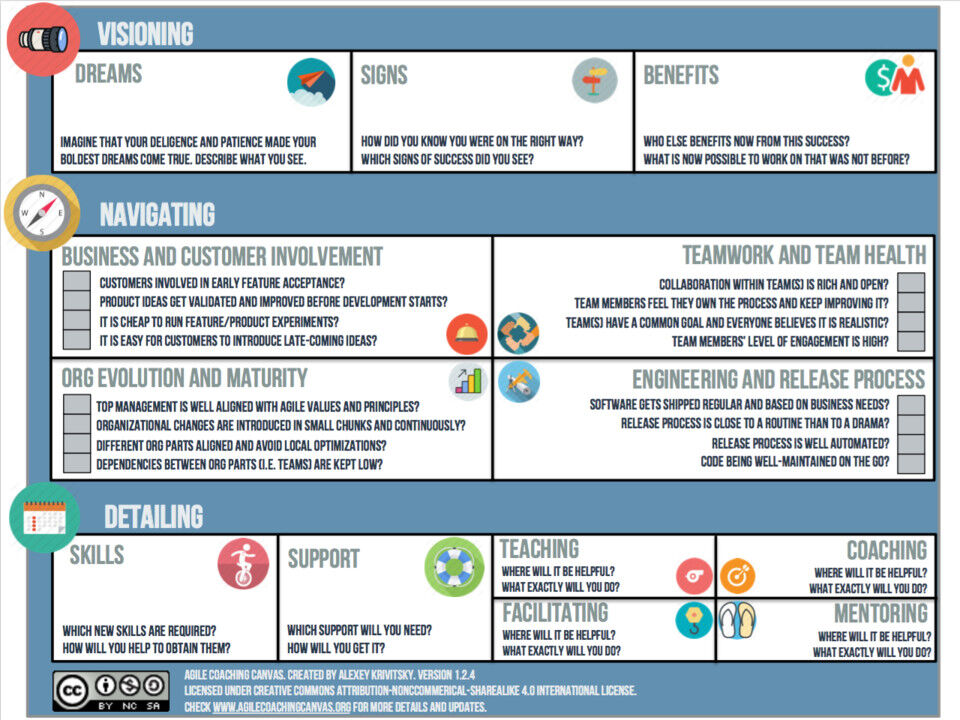
TL;DR:Scrum Masters get lost in routines and forget the dreams that brought them to the job. The Agile Coaching Canvas reconnects you with the high dream: visit your team a year from now in your imagination, then pull specific actions back into next Monday. We like our dreams — the problem is we stop visiting them.
Low and High
I had proposed a session on this topic at one of the un-conferences this year. My fear — my so-called low dream — was that no one would show up.
Well, I was wrong. One person did.
(photo from flickr.com/photos/neilsingapore/)
The guy who came was very eager to learn about the Agile Coaching Canvas, so instead of explaining how it works, I offered him a coaching session to demonstrate it in action. He gladly accepted (did he have a choice?) and we quickly left the room to make sure no one else would join and break up our coaching intimacy.
We went for a walk around the event premises. Sunset, hills and meadows all around us. He was describing his current engagement as a Scrum Master and all the associated challenges — when I kindly interrupted him and asked him to briefly visit one of his teams a year from now.
In the beginning he wasn't sure how. But then he literally didn't want to stop. That's how it usually works — we like our dreams.
Forty minutes later I had to pull him back to the present to wrap up the session and pin down some specific things he'd want to do next Monday. He was very fluent in knowing what to do with his team, though his initial coaching request was to get at least some clarity on the next steps.
Dreaming Never Ends
What's your low dream on reading this article?
Probably that this reading is going to be some kind of yet-another-consultant-bluff about how cool his services, tools and client reviews are. That you'd end up scrolling to the very end only to find zero comments and navigate away to find one to read.
Can be.
And what's your high dream, then?
Likely that this article would make your day and you'd end up sharing it with all your network. (That's also my high dream.)
These two completely opposite thoughts are both dreams. This idea is actually quite interesting, because a typical understanding of a "dream" is that it has to be something high, positive, sweet and inspiring — or else it isn't a dream, it's a complaint.
Well, that's not true. At least partially.
Dreams (as we now know) can be both — low and high — with the full range of amplitudes in between.
And hence all expectations are dreams: we in fact never stop dreaming. Some of us have long-lived habits and preferences for dreaming low, others for dreaming high. But we're all dreamers. That's why this tool — the Agile Coaching Canvas — works so well.
Let me explain.
That Day
Do you remember the day when you learned the news that you actually got that job (or contract, if you're consulting like I am)? You finally got the long-awaited engagement you'd been dreaming of.
How did it feel?

(photo from flickr.com/photos/sking)
I bet it felt good. And in fact, I'm pretty sure right in that moment you started having all sorts of dreams about coming in and changing that team (project, department, company).
You likely envisioned the wide and deep impact you'd be creating, and how everyone would see and appreciate it.
I can't read your dreams (and you can't read mine — which is, by the way, a good thing). But we can come back to them and get reconnected with that great source of clarity and power.
There is only one problem with that…
Lost Dreams
How often do we actually come back and re-live those high dreams during our "core office hours"?
I don't know about you (maybe you're special), but I tend to spend my days juggling daily routines. I barely have time to do anything else. Not to mention dreaming. (I'd love to see the face of your boss when you log an hour for a dreaming activity in your timesheet.)
We forget our dreams. We lose them. We get lost.
Lost Dreams of a Scrum Master
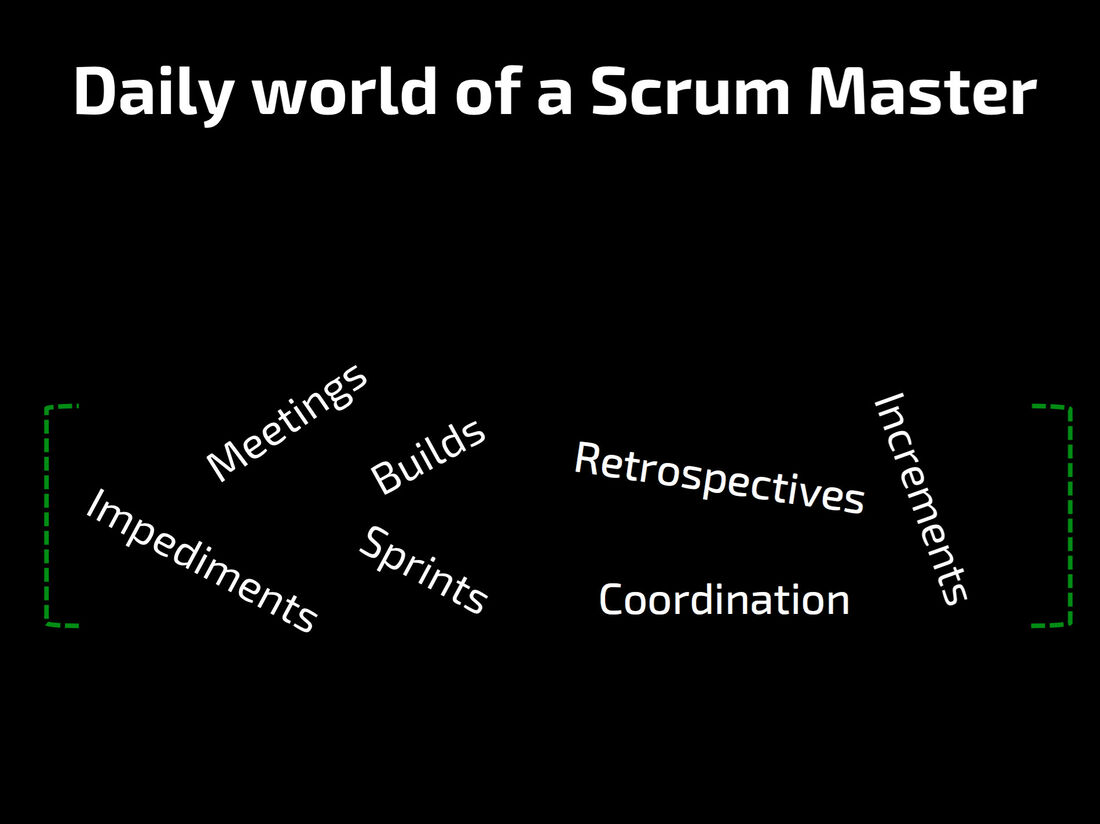
If you're working as a team coach or a Scrum Master, your "job description" — or in other words, "what they expect you to be 100% busy with" — likely boils down to a list of repetitive low-level tasks:
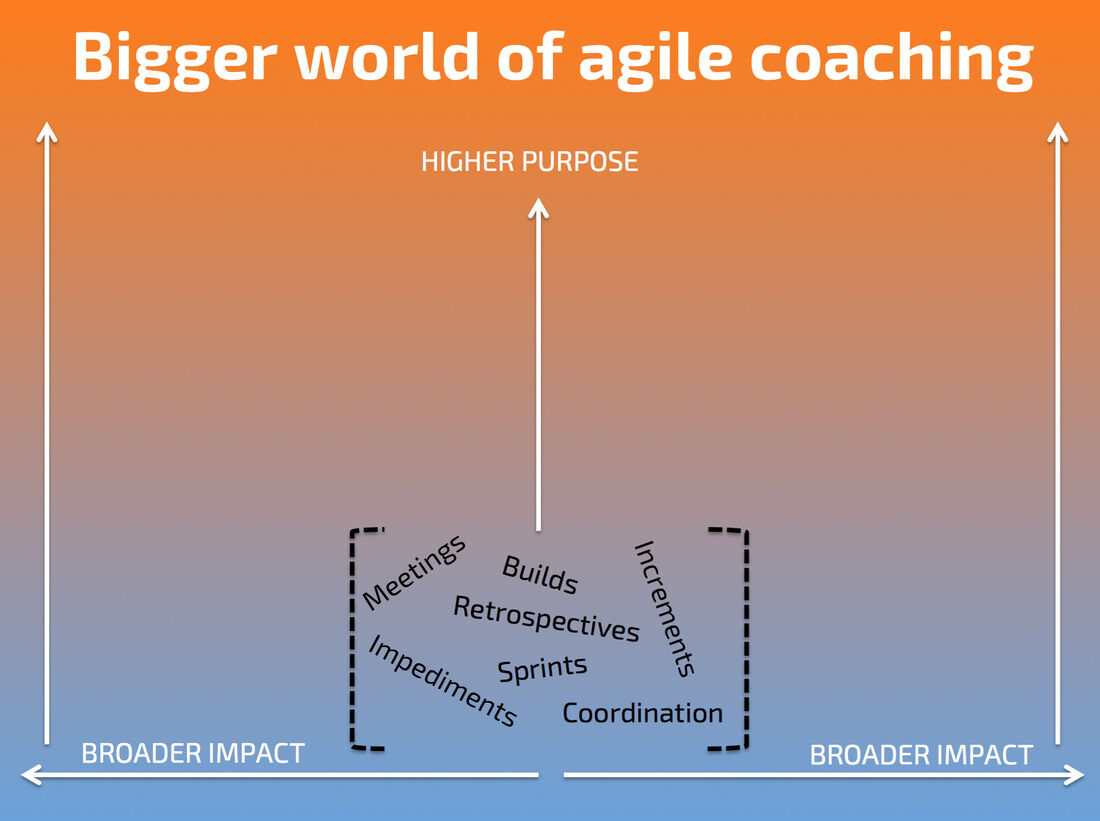
Instead of being the change agents — the ones who keep the flame of Agile and Scrum values burning — most of the Scrum Masters I talk to end up following that routine list.
Talking to hundreds of Scrum Masters a year, I know this is true for most of us. And this has become my low dream of ScrumMastery as a profession. It's a sad one of mine, and I'm working hard to change it.
Dreaming Up
One way to change the impact of our work as Scrum Masters and agile coaches is to go broader: work with more teams in the organization, with stakeholders, with the overall product organization, serving the entire value stream. That's going wide. If you stay narrow, you risk becoming one of the Scrum Masters who are getting fired because the role never reached its potential.
Another way is to get reconnected with a higher purpose without redefining the status-quo scope of the work. That's going higher.
These two directions — higher and broader — are not mutually exclusive.
Getting High
Some time ago I published an article — ScrumMaster is not (just) a Team Facilitator — which got rather positive traction in the community. That one was about going wide.
Today, I'd like to offer you a way up — a way to reconnect with your high dreams without redefining your current job description. You can also call it "hacking a job description", because no one can stop us from dreaming big and acting bold.

(photo from flickr.com/photos/arselectronica/)
So here it goes.
You're lucky. You have a chance to visit your team (department, project, company, client) a year from now. For a very short period of time. Intrigued?
Three… Two… One… You're there. Bam!
Let yourself enter the building.
To your surprise, everything you had been working on and hoping for a year ago did happen.
And not only the way you thought it would — it is exceeding your expectations.
You and your colleagues have been working really hard yet very efficiently. Now simply enjoy observing the result of those great returns.
Notice what's different as you walk down the halls and rooms of the building.
What's on the walls?
What's on people's faces?
What are people doing?
What are they talking about?
What's the energy there like?
What is slightly different?
What has drastically changed?
Pause now to take some notes. Jot down the key observations you'll be taking home with you.
How is what you see impacting you?
Who else is benefiting from these changes in the organization? Stakeholders? Clients? Who else?
Now stay there for as long as you'd like, and let me know when you're back.
Ground Control to Major Tom
I do hope you allowed yourself to spend a few minutes dreaming. If not, please do. You deserve it.
And you should know one thing: those dreams are no one else's but yours. You have all permissions to have them. It is your birthright.
If you don't dream them — no one will. So please, take some time and allow yourself to dream.
Skills
Now, Major Tom, provided you liked that dream:
- Which individual skills do you need to deepen in order to make those changes come true?
- Which skills do people around you need to deepen?
- Which new skills would help if they start acquiring them?
- Which new habits to gain? Old ones to forget?
Support
In order for your dream to stay coherent with the environment you're in:
- Whose support do you think you need to seek?
- If there is one person you really wouldn't want to open up to and share your dreams with — who is he or she?
- Who else can impede your dreams? What can stop them? How? Why?
These are the people you'll need to learn how to connect with in order for the dreamed future to happen. They'll need to be onboarded.
And you know what — they also have their dreams. The low and the high ones. So instead of seeing them as your "impediments", why not start some light discussions about what they are hoping for? Let them dream out loud.
You'll be surprised how much easier it is to reconnect with people on the dreaming level.
P.S. Become the Dreaming Master
The Agile Coaching Canvas is a compact, illustrated guide you can use to keep dreaming — and to help others do the same.
I often use it with the fellow Scrum Masters I mentor. I also run so-called futurespectives with agile teams to get collective dreaming going.
The goal of using such tools is to distort (at least a little) the stiff perception of reality we all have — and help us see new options, other perspectives, and fresh ideas on how to get where we truly want to get.
Not to mention: dreaming is a very emotional process that stays long in our memories. These bright pictures then work as our best motivators, helping us persevere in the harsh times.
So if you've followed me through this article and allowed yourself to dream — you already know how to use this tool. In a nutshell. There is a bit more to it, as the ultimate goal is to facilitate some specific actions, something we'd do differently "next Monday".
Hence — feel free to download the Canvas and its accompanying materials and master this simple yet powerful dreaming toolset.
BTW, it is free and open-sourced.
Alexey Krivitsky
Co-author of 10X ORG and co-creator of Org Topologies. Helps organizations rethink, redesign & rewire themselves for the AI era — from the codebase to the boardroom.

As a full-stack consultant, I operate across all three layers — AI Fluency, Team Flow & Org Fit. Talk to me to get a custom offer that matches your organization’s maturity to drive the impact.