Fluid Form Factor: An Org Model for the Agentic Age
TL;DR:A fluid model for organizing product engineering in the agentic age.
Here is the org model I've been building over the past months: Fluid Form Factor.
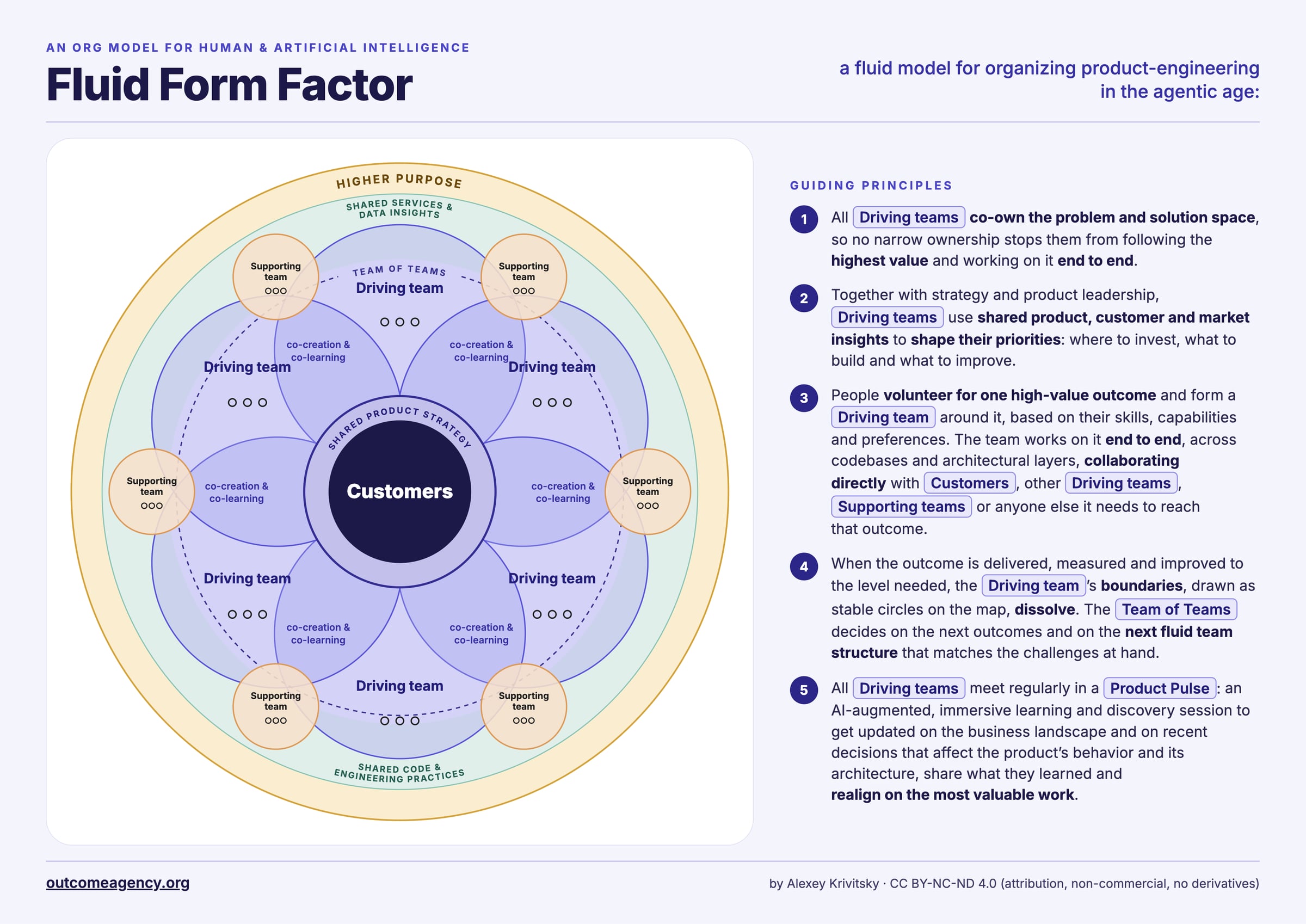
An org model for human and artificial intelligence: a fluid model for organizing product engineering in the agentic age. Tap the image for the full-size version. By Alexey Krivitsky, outcomeagency.org, CC BY-NC-ND 4.0 (attribution, non-commercial, no derivatives).
Guiding principles:
- All Driving teams co-own the problem and solution space, so no narrow ownership stops them from following the highest value and working on it end to end.
- Together with strategy and product leadership, Driving teams use shared product, customer and market insights to shape their priorities: where to invest, what to build and what to improve.
- People volunteer for one high-value outcome and form a Driving team around it, based on their skills, capabilities and preferences. The team works on it end to end, across codebases and architectural layers, collaborating directly with Customers, other Driving teams, Supporting teams or anyone else it needs to reach that outcome.
- When the outcome is delivered, measured and improved to the level needed, the Driving team's boundaries, drawn as stable circles on the map, dissolve. The Team of Teams decides on the next outcomes and on the next fluid team structure that matches the challenges at hand.
- All Driving teams meet regularly in a Product Pulse: an AI-augmented, immersive learning and discovery session to get updated on the business landscape and on recent decisions that affect the product's behavior and its architecture, share what they learned and realign on the most valuable work.
Several of my clients have been asking me the same questions lately:
- Do we still do Scrum?
- Do our two/three-week sprints still fit?
- How should our product owners work when writing the spec takes longer than coding it?
- How do we cope with so many product changes running in parallel? What must we keep under control, and what can we let go?
- And how do we unblock our teams, now that they can go much faster, in theory?
- What's the new team structure and recommended team size?
- Do we need teams at all? How stable should they still be?
The larger question behind this quest: when the frameworks of the pre-AI era stop fitting, how do we organize product engineering so that people and AI agents drive outcomes, not only produce output?
The Picture, From the Inside Out
- Customers in the center, with one shared product strategy around them.
- Driving teams. Each forms around one high-value outcome, works on it end to end across codebases and architectural layers, and talks to customers directly.
- When the outcome is delivered, measured and improved, the team's boundaries dissolve. The Team of Teams decides on the next outcomes and the shape of the next teams.
- Supporting teams with a narrow mandate: services, consistency, guidance.
- A shared layer of code, engineering practices and data insights. No team owns a component, so any Driving team can go wherever the value is and has the data to judge its decisions (see Avoid Premature Platformization).
- A higher purpose, shaped and shared by strategic leadership, that holds it all together.
Why Now?
AI agents make learning a new area cheap. A team can move to new work without months of ramp-up, and that weakens the main argument for fixed component teams (a real example: from component teams to Team Topologies to FaST Agile).
All Driving teams meet regularly in a Product Pulse: an AI-augmented learning and discovery session to catch up on the business, share what they learned and realign on the most valuable work.
None of this is invented from scratch. It builds on the Adaptive Topology from Org Topologies, LeSS, FaST, Team of Teams, Haier's RenDanHeYi, Bayer's Dynamic Shared Ownership and more (see also How Adaptive are Team Topologies?).
For the interactive model, see Outcome Agency, a fluid org model for the agentic age.
Alexey Krivitsky
Co-author of 10X ORG and co-creator of Org Topologies. Helps organizations rethink, redesign & rewire themselves for the AI era — from the codebase to the boardroom.

As a full-stack consultant, I operate across all three layers — AI Fluency, Team Flow & Org Fit. Talk to me to get a custom offer that matches your organization’s maturity to drive the impact.