Agile Teams Working From Home, WTF?
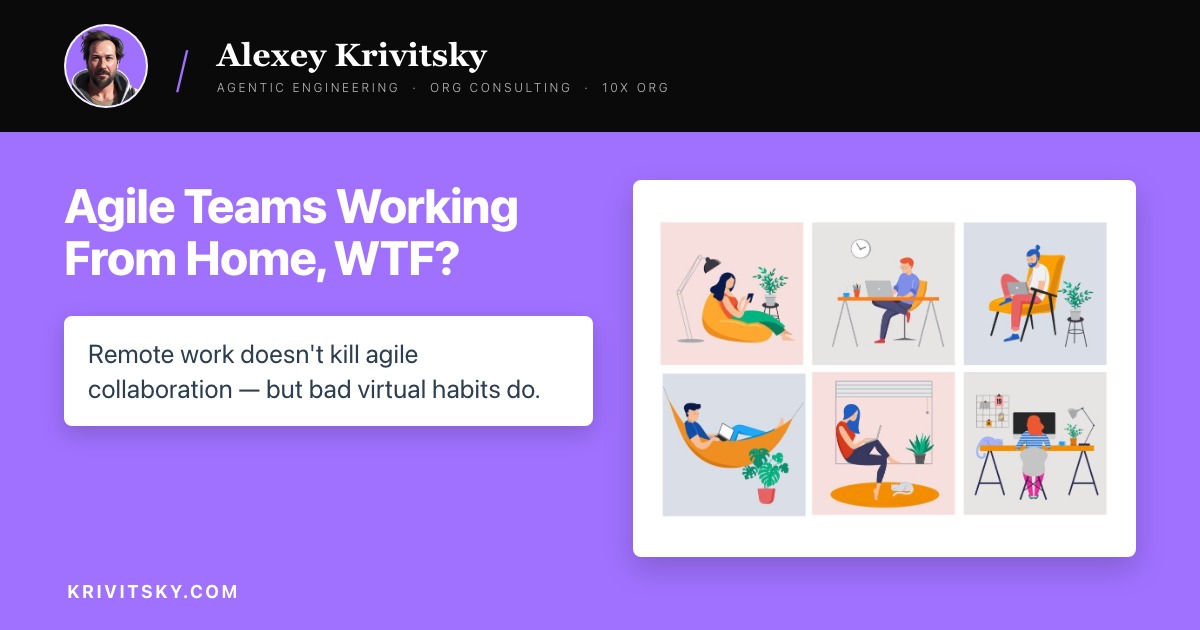
TL;DR:Distance is a thing of mind, not space. You can be remote in the same building and close across continents. The key question is not how to be productive at home — it is how to build a virtual office where teams feel present, connected, and keep improving. Think virtual office work, not remote work.

Yes, and you'd better start building good habits earlier
In the space of modern management — agile — we value face-to-face communication because it is proven to be the most efficient way of conveying ideas that we know of. It is so much easier to clarify misunderstandings and build a shared vision when talking than when emailing or chatting. I've spent the last 15 years breaking down every wall and barrier, physical and metaphysical, that stops individuals from creating environments of rich and diverse collaboration.
Are those times now gone for good? Did the last week change the world of work so that there is no space for rich face-to-face communication anymore, because everyone is working from home? (For a research-based perspective, see my later synthesis of remote work studies.) Is the agile mindset now obsolete? Do all the agile coaches turn overnight into proponents of distributed work and remote coaching? Hope not. Sure it is not. Quite the opposite.
Remote work still sucks — and it is not about the distance
I remember my first job as a junior developer in 2001. I shared an office with a dozen other software engineers on the 2nd floor. I was given a project and assigned someone with testing skills to help me ensure quality. She, my testing lady, sat on the 4th floor. Same building. A real distance of some 50 metres. About 60 seconds from desk to desk when running up the stairs (I did run a lot of stairs those days). We used ICQ to chat and FTP to share compiled binaries.
Despite our short distance I felt remote and lonely. Especially when she didn't return my ICQ messages or set 'away' when I needed to come up and see her immediately. We were remote even while in the same office, quite close to each other. On my next project I got another test engineer and he sat on my floor, four doors down the hall. Far closer. Far easier to reach. Yet the same issues.
Four years later I joined a company opening a dev centre in Kyiv with all the management and client representatives based in Odense, Denmark. Video conferencing was already a thing, internet channels were almost good enough, and we used that opportunity heavily — hours per day. Two offices, 1,500 km apart, four hours of flight and train commute. But, boy, we were really close then — mentally close.
Proximity over distance — virtual doesn't necessarily mean remote
Most of us have similar stories. And those who do usually feel that distance and proximity are more things of mind than of space. You can be close to someone on another continent and yet feel as far strangers from someone sitting on your sofa. The same goes for remote work.
So instead of remote work think virtual office work. This is where everything we've learned by coaching team collaboration, building team trust, and helping teams reach shared understanding can and must be applied today.
The key question of today is not "how can I be productive in a home-office environment" but rather:
"How do we create a virtual office space where everyone feels connected and close to each other, as if they were physically together?"
It is not about the tools — despite what the ads say
Before writing this article I googled what had been written on this in the last few days. A lot of posts are endless reviews of tools they say you need to use to make it all work.
Bollocks. Tools help, that's for sure. But you will get very little benefit from tools if you don't get the principles right. And vice versa: if you understand the principles of building mental closeness, you can use basically any set of tools — even free and sloppy ones — and still be better off, because you grasp what makes people feel present and connected.
Principle #1: Virtual presence
Are you present today at work? Can you feel others being present too? Or do you feel puzzled, lonely, and isolated?
That's about it. We need to help people feel surrounded by each other, like in those good old office times (remember those — it was, like, what… two weeks ago?).
Practices that help to implement virtual presence:
- Teams have constant video calls during the day. With a dedicated persistent video conference room for each team, people feel among others. They join when they start working and check out when closing the day. Being in the shared virtual room means: "I'm here. I'm in the office. I'm present."
- Create a feeling of higher interdependence between team members. Independence creates isolation, isolation drives loneliness, loneliness causes depression. (This is also why Autonomitis Blockadus — teams pursuing independence at the cost of collaboration — is such a dangerous pattern.) So add more dependability, maybe even more than needed. How? For instance, work in shorter iterations than you'd normally do, or have fewer high-priority initiatives (backlog items) at a time, so that people have to coordinate and integrate their work on a few higher-priority items. (That's also good for business.)
- Run daily stand-up meetings several times a day. With higher interdependence, the need for coordination should also grow. So why not run team syncs more often? It helps team members feel a shared work space, with clearer plans. And clarity and confidence are very important right now, when the world outside is kind of collapsing.
Principle #2: Emotional connectedness
Having shared work is great, but nothing jells people more than shared emotional experiences, sympathy, and empathy.
Everyone knows how important this soft stuff is, and yet discussion about work usually dominates our conversations. A team facilitator (whoever takes this role at the time — see the role below) needs to incorporate emotional exchanges into the daily work routines.
Practices that help to implement emotional connectedness:
- Start every virtual meeting with a check-in and end with a check-out. This sounds obvious — everyone knows it. But ask yourself how often you actually do it. Besides the emotional exchange, this is also a mandatory step to make sure everyone's headset and microphone are working. Spend at least 10% of the planned meeting duration chatting about how people feel, what's on their minds, what stops them or slows them down. 10% sounds like a huge waste, but it ensures the remaining 90% has a higher chance of being really productive. Check-ins help people raise self-awareness, and hence improve engagement by clearing some bugging emotional baggage out of their minds. Brave enough to do more? Offer a 2-minute meditation at the beginning of a virtual meeting.
- Have a 'team care' facilitator role. We have customer care because customers are important, right? So why not have a team care role? A rotating role in a team, daily or so, focused on relationships, emotions, and all this untouchable stuff — and less on daily work. This dedicated person can offer to run check-ins and check-outs in a fresh format, lead short stretching exercises, conduct a short meditation, host quick feedback rounds — anything goes here, if it helps the team step out of doing the work mode for a short while and focus on improving relationships and connectedness.
- Stop using emails. Email is the most dangerous tool we've created in the internet era, despite its huge benefit. I mean when it is used within organizational boundaries, and especially within teams. Just stop using it for internal team communication. Instant messaging is not much better. Switch to video chats and video calls. We — people — are so much nicer to each other when we can see each other's faces. This is due to the power of mirror neurons and other capabilities of our developed brains to read emotions and reactions in an instant. Evolution hasn't been preparing us for reading emotions by looking at weird symbols someone has typed onto a piece of plastic.
Principle #3: Improve on presence and connectedness constantly
You won't get it right the first time, despite some of the ideas I've shared here and thousands more you can find online. Also because every team is different — and dynamic.
So it is vital to find ways to collect constant feedback, run small experiments, and keep improving the well-being of your virtual office. That's obvious. But again — in an era of turbulence and looming economic crisis, working harder might feel like the only right thing to do. It isn't.
Practices that help here:
- Run short informal retrospectives. Nothing new here. But do them more often and keep them short. A good idea: team members collect their individual tensions, and when the number reaches N (like 3 or 5), run a spontaneous 20-minute retro.
- Find a way to gather constant feedback. Because you don't bump into people at the smoker's corner or the water cooler anymore, you're missing a lot of channels that used to carry important stuff in safe, friendly, informal ways. So find virtual substitutes. Gathering all kinds of feedback helps a lot. It always does. But in times of change and chaos this is more true than ever — especially when the feedback process is transparent and the results are seen and made actionable by everyone, not just by management.
- Act as a leader. We leaders are in charge of creating and sustaining cultures of cooperation — and today, of the emergence of new habits of virtual work. It is important to do it before bad habits kick in. Company cultures are already being dramatically affected by people working virtually. The first days and weeks of the new era are exactly the right time to start shaping and re-shaping your corporate culture. Act now.
Good luck. Wash your hands. And create other great new habits of virtual work.
If you like this train of thought, I've continued with a 17-page micro-book that contains these and other pieces of advice (20 in total): Working from Fucking Home.
Alexey Krivitsky
Co-author of 10X ORG and co-creator of Org Topologies. Helps organizations rethink, redesign & rewire themselves for the AI era — from the codebase to the boardroom.

As a full-stack consultant, I operate across all three layers — AI Fluency, Team Flow & Org Fit. Talk to me to get a custom offer that matches your organization’s maturity to drive the impact.