75% of those using Scrum will not succeed
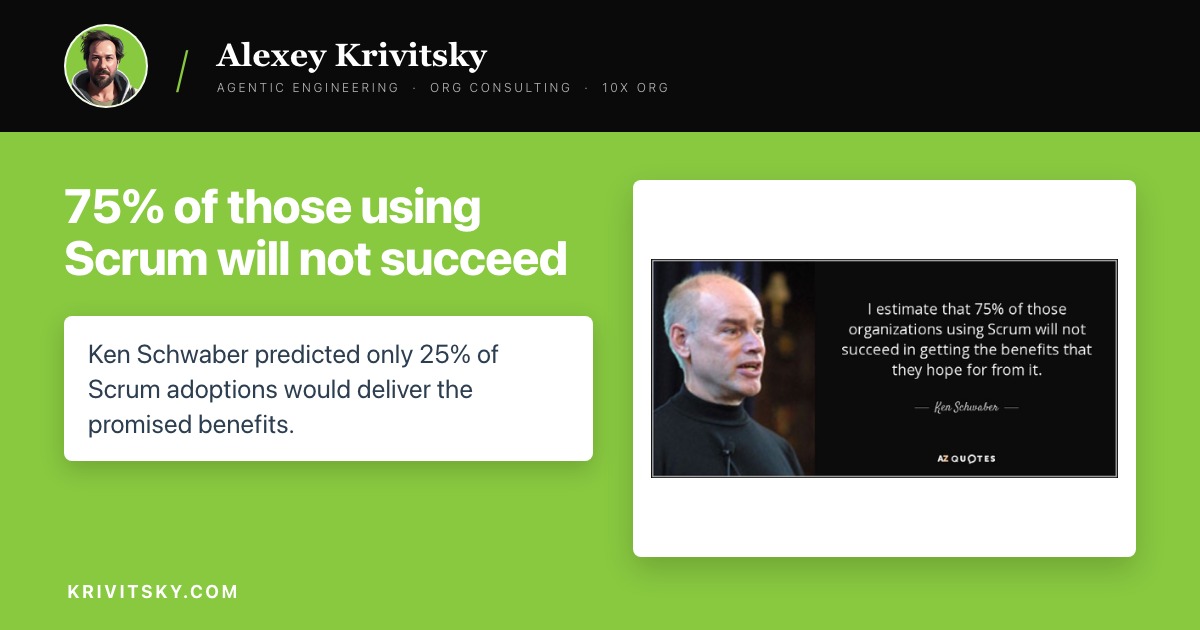
TL;DR:Ken Schwaber predicted 75% of Scrum adoptions would fail. The real number is likely higher. The structural change most organizations never finish: merging decision-making power with frontline information in a single Product Owner role — a product CEO at Gemba. That role rarely exists before Scrum, and rarely gets created after.
A revolutionary method most organizations never finish adopting
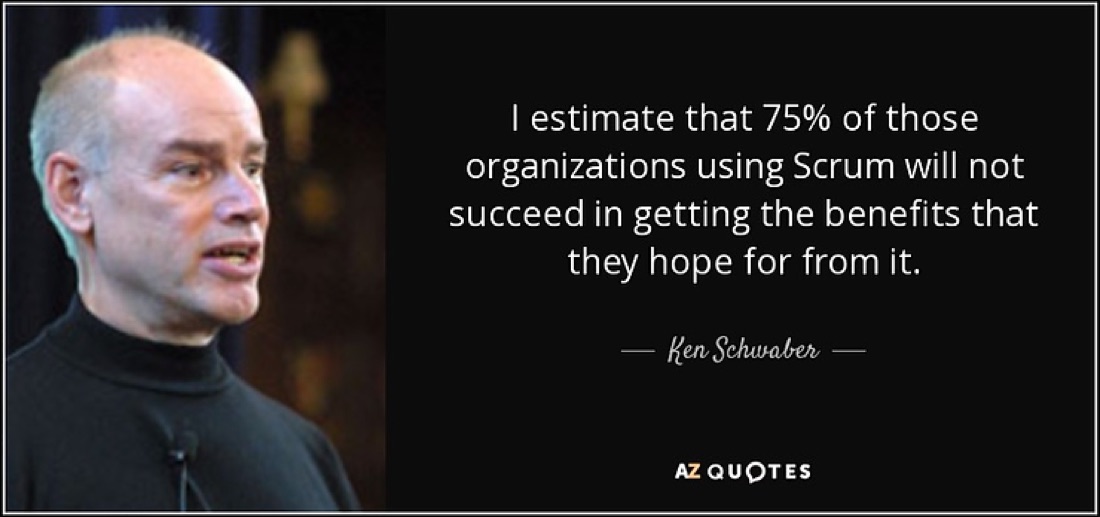
Ken Schwaber, a co-creator of Scrum, predicted back in the days that only 25% of companies would be able to get the promised benefits of the method. After more than 10 years of organizational consulting, I estimate this number to be much lower.
Why? Because Scrum is a revolutionary method that is based on several structural changes that need to be put in place. Many organizations skip these hard parts and end up with what I call Human Framework Dependency Syndrome — hoping a slide deck will solve the problems.
One of them is the introduction of the Product Owner's role. This role has been invented around 30 years ago to highlight a radical structural change that needs to happen.
It is to merge power with information that are usually separated on a classical org chart. This is a decision-making capability at Gemba. A powerful move!
Why true Product Owners are so rare
It is very rare actually that such a role already exists in a given organization before the adoption of Scrum. Yes, there are people with power and others with information, plus many different committees and work groups trying to make all sorts of decisions.
See how those classical dynamics are different from the single "product CEO" who makes informed decisions just-in-time by being involved in the act of product development with quick learning cycles being assisted by a group of committed, knowledgeable people. Without this structural change, Scrum contracts to the team level while management layers multiply above — what I diagnose as Scrum Shrinkingitis.
That's why it is so rare.
The challenge of elevating product management is at the heart of this gap. I am re-watching interviews with Brian Chesky, the AirBnB CEO. He is just fantastic. And, although, he does NOT call himself a product owner (who in the Silicon Valley does?), he's very much describing the same dynamics that I would expect from the true PO in Scrum.
Alexey Krivitsky
Co-author of 10X ORG and co-creator of Org Topologies. Helps organizations rethink, redesign & rewire themselves for the AI era — from the codebase to the boardroom.
As a full-stack consultant, I operate across all three layers — AI Fluency, Team Flow & Org Fit. Talk to me to get a custom offer that matches your organization’s maturity to drive the impact.